Avineil Jain

Thought Structuring, Pre-Placement Preparation, Day One, Opitver, General Tips and Tricks, Before December, On Placement Day

Profile at a Glance

Internships:
○ 2nd Year Summer Research Intern at George Washington University (Physics)
○ 3rd Year Winter Intern at Viacom18 (Strategy Intern)
○ 3rd Year Summer Intern at Schlumberger Technology Center (Software, Analytics)
POR’s:
○ Head of the first Data Analytics and Visualization Team of IIT Bombay
○ ISMP Mentor
○ DAMP Mentor
○ Electronics Club Convener, STAB (Now comes under GS Tech)
○ Mood Indigo Convener
● Semester Exchange to National University of Singapore

Thought Structuring and Getting Perspective

I first had to think very seriously about placements because I mostly wanted to go for Masters after IIT and was pretty sure about it. But looking at some of the lucrative JAF’s that opened, I decided to give placements a chance and target specific companies. I spent some time analyzing my strengths and dislikes. I came to the following conclusion
Strengths: Quant, Analytics, Deep Learning and ML, High CPI
Dislikes: Software Development, Core Electrical and Electronics
Weakness : Lack of 3rd Year POR
Thus, it became evident that I had a good chance at the Quantitative Researcher profiles at High Frequency Trading firms, and the analyst profiles of several finance companies. Also, I had a good chance at AI research profiles that opened at the placements. I also felt the peer pressure to apply to consulting companies, just because everyone was applying to them. However, I realized through my talks with my ISMP mentor (who was in consulting for a few years) that consulting is not something that I would want to do, and with a very strong will, I decided not to sign the consulting JAF’s.
I used the technique of elimination to arrive at what profile I wanted to target. Looking at my dislikes, it was pretty obvious I wouldn’t sign any core profile or any software development profile for placements. This eliminated more than 80% of the JAF’s for me. Good. Through my DDP I also realized that I do not possess the skill-set for academic research so a PhD or an RnD profile in a core company was also eliminated. This also meant, that despite my strong profile in ML, I did not sign any lucrative high paying AI RnD positions.
Looking through the various JAF’s that opened, I utilized a strategy that I felt really made my placement process stress free. I only signed JAF’s for the companies which I actually wanted to join. Note that in my case, I had the option of choosing masters as well (since I have a pretty high CPI), so I really wanted to put my efforts to companies for which I would leave masters if I got an offer. This made me only sign around 18-20 JAF’s in total out of which I was serious for only 3-4 companies. I told myself that I would seriously prepare for these 3-4 profiles. Obviously this strategy is not for everyone, but for those who can afford it, this approach will be beneficial. This approach really helped since I avoided giving a lot of tests which get really stressful, and instead gave me time to focus on my DDP and prepare for the profiles I wanted.

Alternatives

As mentioned, there was only one alternative for me. Either an offer from those 3-4 companies, or masters in US. So I also gave GRE and TOEFL in Aug-Sept, and started applications as well. I got 331 in GRE and 118 in TOEFL. I realized that an MBA in India is not something I wanted to do, and so CAT was eliminated from my options. I also did not want to pursue Civil Services at that time, and so that option was out as well.

Pre-Placement Preparation

With the above strategy, all I had to do was prepare for Quant (Probability and Puzzles). I practised it using some textbooks, as well as online sites for puzzles. Turns out, I got shortlisted for Blackstone as well, so I had to prepare for cases as well. Case preparation took a lot of time, and frankly, I wished I had signed for consults just so that I could get more case preparation. I also practised sequences, and quick math for trading profiles.
I took all the tests seriously, and since I had to give so few tests, it meant that I could prepare well for each of them. I also attended PPT’s of companies I was serious about, and talked with some of the employees, since it gave a lot of perspective of whether I actually wanted to work there. The one thing which I really hated about the process was the PPT rule, which meant that I had to waste time and attend PPT’s for companies I did not want to join, just to fulfill the weekly quota.
I would recommend forming a nice case group to prepare for case studies. Often having 2 groups is perfect, since not everyone would be available all the time. Also, just 4-5 days before the placements, sit alone in a room, and really think about yourself for HR. I really had to come up with clear reasons of why I wanted to join a particular company, since I wished to appear genuine and give proper reasons as to why I wouldn’t pursue higher studies.

Tests

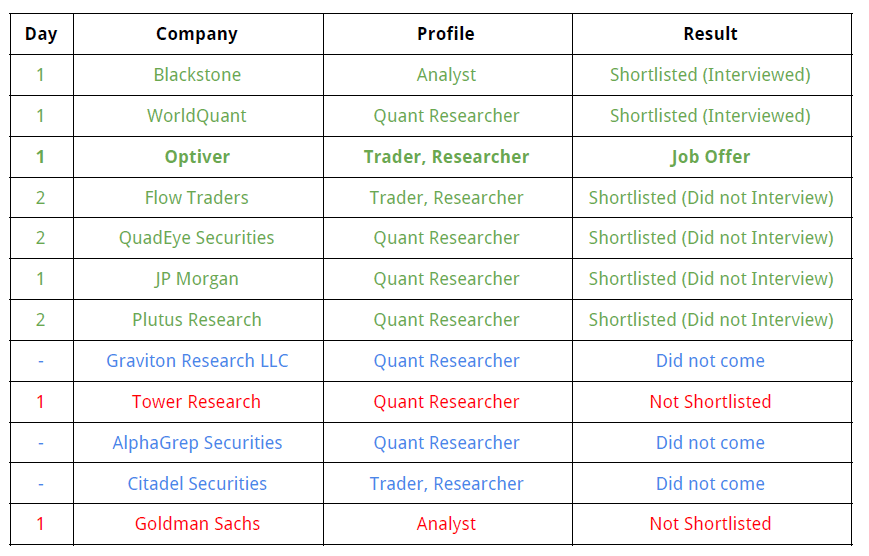
Almost all my tests went well, and with the exception of 1-2 companies, I got shortlisted in almost all of them. The test for WorldQuant was brilliant, with fixed time limit for each question, and the question themselves were excellent. I had a good time giving the test. I felt quite stupid in the tests for Tower and Goldman Sachs, since they asked coding questions and having not prepared anything for coding at all, I could not solve those relatively simple questions, and to no surprise I wasn’t shortlisted in them.
One advice to all candidates would be to prepare, at least till an intermediate level, for algorithms and data structure questions, even if you won’t be sitting for Software. It keeps the mind sharp, and is always useful.
Another test which I found super fun was that of Optiver. It was divided in 3 parts, and tested a lot of different skills. The test for Flow Traders was similar, and I did well in both. For all other Quant Researcher profiles, I found my preparation sufficient enough and was able to clear the tests.
The test for Blackstone was fun as well. They taught us basic accounting in their ITS, and questions were limited to what was taught. Quick calculations and approach was tested, and it went decent for me.

Group Discussions

I only had one group discussion, which was for Optiver. It was basically a market making exercise, and they had given us a document from which we were supposed to read and prepare. I prepared with two of my friends, at 2 separate occasions, and was comfortable with the market making game. The GD went well, although I later realized some of the mistakes which I had made, and I got shortlisted for the interviews.
Day One

I did not sleep well, and waking up at 6 hardly helped the cause. However, the insane rush of adrenaline and nervous energy was more than enough to keep me going. Suited up, clean shaved for the first time in my life, I was ready to be “an adult”. I had 2 companies in Slot 1 and 2 companies in Slot 2, and I absolutely wanted to crack a job on Day 1 itself.

Blackstone

Blackstone interviews are a different beast. I had 3 interviews in quick succession, two by Managing Directors, and one by an associate. The 2 interviews by MD’s were stressful, and they really were thorough with the HR aspect. Both the interviews involved a small case, and mostly HR questions. The third interview was some calculations and HR again. They told me that they had found a better candidate, and somehow I did not fit in, so my chances were bleak. So I decided to give it my all to the second company, which is WorldQuant.

WorldQuant

WorldQuant interviews are the antithesis of Blackstone interviews, at least for me. The atmosphere was so chill, the interviewers were so chill that I instantly felt at ease. I had to give 5 interviews for WorldQuant, and with the exception of 1, all others were technical interviews with the interviewers grilling about my resume, my research, asking a lot of puzzles and probability. Having prepared well, I fared well, and I felt I had a good chance to bag the job. The results would be out by the night, and I would know how well I had done.
Slot 1 was done. I went back, had a good lunch and slept for sometime, knowing that the battle was still on. I woke up and went back to H16 for Slot 2.

Optiver

Optiver was in slot 2, and the company takes you directly to Amsterdam. I wanted to work in Europe, and the trader profile seemed exciting enough for me to give it my best. Not to mention, the high bonuses (:P). My first interview was a technical one, and boy was it fun! It was a pure skill based, quick math based interview where I had to calculate a lot of things quickly in my hand. There was also a super interesting puzzle which they gave. I could solve that puzzle, so I felt pretty good about my chances. The HR interview went pretty well, and I was called for a third interview, this time for the research profile. It was 10 PM in the night, and my mind was on the verge of collapse. I was not thinking quick enough, and although I did okay, I felt I had bombed the interview. The interviewer let me know that it was a negative for the research profile, and that I had to wait for the results for the trader profile.
This meant a nervous 3-4 hour wait, and to add to the tension, they told me that I might be called for another interview at 1 AM. I went back to the room having skipped the JP Morgan profile completely, since I felt I had good chances at WorldQuant. I ate the dinner, and having been completely exhausted, it was a pretty nervous wait. I got a call at 12:45 AM that I was called for another interview of Optiver. I dressed up again, and went back to H16.
What happened next is something that I will remember for the rest of my life. I expected an interview, and with loads of caffeine running in my blood, I was ready for it. I went in the room where I had the technical interview, and to my surprise the HR guys entered the room as well. They all closed the room, and instead of an interview, they offered me the job! I came out extremely elated, having secured one of the profiles which I wanted. I went back, completely satisfied with how my placements went, knowing that I am going to Europe in 2019 !

Tips and Tricks to land that dream job!

One thing is clear. Getting the dream job after IIT is not easy, especially with some many students vying for those coveted few positions. Smart work, and being true to oneself can go a long way in simplifying the process. If you don’t wanna do software, or if you don’t wanna do consult, don’t sign the JAF just because everyone else is doing so, or because it pays more money. Being honest about what you want to pursue and more importantly, what skills and the profile you can show during the interviews helps a lot to sound genuine and impress the interviewers more.
Another thing to keep in mind is that despite some people telling that CPI doesn’t matter, IT DOES. There are some profiles such as consulting or trading for which CPI might matter less, but for most of the other roles, having a good CPI gives an advantage over other candidates. Also, it is undeniably true that software roles have a much higher salary than core jobs, with the exception of Electronics based jobs. Most jobs pay in the range 10-20 lakhs, so do not be disappointed if you don’t see those 1cr packages. Salary depends on the place and country you are working, and converting everything to Rupees is a terrible idea.

Before December

● If you are absolutely dead sure that you want to pursue a PhD, do not sit for placements just because you want a job. While it sounds safe, I have seen a lot of my friends focussing on applications because they were sure about their priorities. It is highly stressful, and to be honest, just giving a half-hearted attempt to placements will do you no good.
● Listen well to the PPT’s for the companies you are interested in and be sure to ask about the other side. Most companies only show the good side of the job, and leave out the stress, or bad work-life balance of the job.
● Don’t randomly sign JAF’s left and right, because you want to play it safe. Take some time to figure out the 2-3 profiles which you like and select those companies. In any given slot, only 2-3 companies are possible to manage, hence getting shortlisted for 10 companies on day 1 doesn’t mean anything if you can’t complete the process of even one.
● Prepare well for the tests and take them seriously. Do not rely on the last minute preparation that everyone gets used to in IIT, because it simply doesn’t work.
● If you are weak in the aptitude section, prepare well for it by solving CAT material. Having a good grasp of sequences, probability and puzzles always helps in the interviews.
● For BTechs, it can get particularly taxing, hence remember to choose chill courses which don’t require a lot of assignments or efforts. Towards the end, all the (tests + endsems) can get super hectic, and it is always beneficial to have less academic pressure.
● For Duals, work really hard in the early part of the semester and get your DDP1 done as quickly as possible. October and November are crucial to do well in placements, and no wonder DD students do well in placements, since they have so much time to prepare well.
● Reach out to a lot of seniors who are working in the companies you are interested to join. Talk to them comprehensively and get an idea about what the job entails. Too often, the jobs are not what they seem and this can lead to dissatisfaction.
Prepare a timetable and stick to it. The placement semester might be the most important semester career wise and be ready to work hard. Slacking off in this semester might prove disastrous! Give it your best because placements only comes once, and the ease of having so many companies coming under one roof is unmatched anywhere else. #NoRegrets
● Be clear about the reasons for joining companies offering profiles which are polar opposites of the profile your resume shows. Being genuine again goes a long way to convince that you want the job and are the ideal candidate
Spend some time to prepare well for HR questions. This might be easily the most overlooked aspect of placements, and having a good grip on your resume, and your HR questions is crucial to getting that coveted job.
● Fluency in English is a must unless you are brilliant and fit for the profile for which the probability is quite low.

On Placement Day

Dress well, invest in a good fitting suit, and have good trim of the hair and beard for males, and a good haircut for females. Physical appearance, and the first handshake contributes to the first impression which plays a major role.
Be confident in all your interviews, and never bullshit or brag about your points. The interviewers have done this too many times, and are aware of the extent of the impact of your intern or POR.
● Plan well for the slots, and keep a friend with you who will coordinate with the company officials (called the “runner”). You are too busy to plan for the next interview, and having a good “runner” is absolutely crucial
● Be smart about your decisions and ensure you give as many interviews as you can for the company you actually stand a good chance for, and which actually show interest in you.

All in all, Placements are an amazing experience, and everyone has something to learn from it. It is highly stressful, and to some extent luck based, but if you deserve a good job and have worked hard to prepare for it, you will end up with something good! Even if you don’t, this job is not gonna be the last one in your career 🙂

All the best!

Swapnam Bajpai

Resume, Day 1, Day 2

We all like to think as ourselves being reasonably responsible in the matters of our own
success. Yet everyone’s story comes with its own internal context. There is a whole infrastructure of support and guidance upon which all achievements stand. More often than not, being around the right people and having access to the right information makes an ocean’s worth of difference.
Let’s put it like this, it begins somewhere around the end of your second semester, and near the beginning of the third, but you don’t know exactly where.
But it’ll happen, nevertheless.
So on of those days, on your usual walk, Dylan perhaps, you come to a realization.
I have not started it. Yet. How much time do we have on our hands?
So that day you go back and open up the website they are talking about.
GeeksForGeeks.
(This is a CSE review. And this is not sponsorship 😛 , this is a personal experience.)
Which problems has everyone else done, Arrays first! Two pointers, now across types, Graphs, never forget breadth first search, Holy Grail, Dynamic programming, BitMasking, maybe not…
Avoid getting tangled up in the dichotomy of ‘Do I see the solution? Or do I keep trying?’
Do what keeps you going. Keep the forward momentum in place. Assuming you have boarded the train two months to the deadline, which is mid October, ensure that you think over at least two or three new problems every single day. Missed a day? Ok. Do not miss the next. You don’t need to be world class (doesn’t hurt if you are), you only need to be reasonably good. Starting to think in the algorithmic sense, that is what the tests are designed to test.
It cranks up as the examinations approach. Everybody joins in. Group tests. Maybe rank doesn’t matter much? Hey, I am in the top three of an interdepartmental competition!

Finish the Resumes

They are like loans, you cannot altogether skip taking them nowadays, and you want to get rid of them as soon as possible.
Resume? Good question.
Each course has a concrete final theme you reached. You read each individual result, you see the connections, you see the soul. Keep an entry each to put up milestones of that five month process.
Published something?
Completed and submitted a project?
Gave a seminar?
Read important papers?
Noteworthy implementations?

This already fills up the page. Describe your seminar and term projects as personally as
possible. This comes on top. Say it out on paper as you have gone through it. What were you trying to answer? Where have you reached? Where are you going?
Extra curriculars? Oh well…
The rest of the process is more or less mechanical, fill in JAFs, ask seniors the core details of the companies, check if the location suits you, the work culture, prospects for growth. Ask on groups so that lazy people like me come to know stuff too. Do not mess with the attendance in PPTs and other events, that is an idiotic risk, problem practising every day, how many shortlists do we want, ten, fifteen, maybe, I don’t know, twenty two? And what is this day and slot rigamarole?
Enter the tests.
They are over sooner than you’d imagine. The day is a complete daze. You stop thinking about the results at one point, another form to fill, maybe I’ll attempt the harder question first, how about the easy ones rather? 2 in 3? 1.75/4 I don’t know, someone said they solved five more test cases…
Do not panic if you are not shortlisted in as many companies as you had hoped for. Most of those repeated appearances will get somewhere by the end of the second day, and almost all companies will open up resume submissions for every one. Prepare for what you are going to do once you land up in an interview, you are guaranteed to get more than you’ll need, eventually.
I ignored the entire CSE undergrad curriculum, because I was banking on my resume being heavily oriented towards Algorithms and Computational Complexity to drive the questions in that direction. That is perhaps the only mistake I made. Take fifteen days to revise all of your core Computer Science fundamentals. You’ll end up teaching them to those who did not. You do not want to be the one listening to rudimentary but essential facts about TCP and Virtual Memory ten minutes before your interview begins.

Day One

I walked into Microsoft after congratulating a friend who was selected within a single round, and was off to Google. (He got selected there too.)
Nerves. Sweat. Suddenly my resume feels woefully lacking.
Twenty minutes in, staring at the page with three different versions of my proposed solution, water doesn’t help. The interviewer smiles.
Round two. Smiles. Shake of hands.
Rejected.

Apple. Two technical rounds. An extra HR in this one. Smiles. Shake of hands.
Rejected.

I am not going into the questions as such. It is all about thinking algorithmically and applying techniques that you have at your disposal. One could go into a finer level of granularity : Microsoft is known to stress upon linked lists and binary trees, but then, maybe next year they’ll fancy asking Dynamic Programming, or maybe switch to Graph algorithms. The only way out is to be prepared for everything.
The essence of every tech interview is the same. They are not looking for the correct solution within a minute. In fact, they might get suspicious of you already having seen the solution if you converge on to it that fast. Unless of course if you really are a seasoned coder and can come up with every answer immediately.
If nothing, suggest the worst way that occurs to you. Now tell him where does the inefficiency creep in, and what alternative ideas you have. Ask him for hints. Do not sit silent hoping the question will change and the ordeal will get over. The ordeal is the whole point.
In one sentence, they are looking for people who can think for themselves, and come up with ideas in a high pressure situation.

Day Two

My first company was Flow Traders, and I had placed it on top of my preference list. This was the one I wanted.
The first round was a fairly straightforward one in which I was asked to write basic object oriented code in Java. A few fact checks about the language, multi-threading, access modifiers.
It got over in twenty minutes.
Then there were two HR rounds that lasted for an hour. As far as I know, this is the only company that places a serious importance on your motivation and drive to join them. Being my first choice anyway, I breezed through the discussions, which centered around my career trajectory so far, the reasons I wanted to go to Europe, and in particular the Netherlands, what information did I have about the kind of business the company was involved in, where did I see myself in the company in a few years. There were even a few questions on my projections of the culture and people of Amsterdam.
In short, they are looking for people with a passion for the job profile they are applying to. It sounds fancy, and perhaps even frivolous, but whether or not you are clear headed on why you want to work for them, and them alone, will be about eighty percent of the reason why you were selected, or not.
(For added details, watch the last scene in The Pursuit of Happiness.)
I had appeared for three more companies and was smoking away my headache when the news of the acceptance came in.
Do not lose your head. This will test you. Not merely each question. Not the individual interviews even. The process. It is a very primal experience, competition. This is how we evolved. The world is built upon the contributions of men and women who looked at problems and raised their hands up with the little ideas that popped up in their heads.
Best of luck and yes everyone will get placed but the one thing that they do not tell you is that when one half of the whole gets there on day two you do not want to be part of the other half.

Be prepared!

Praveen Kumar

Research Areas

Digital VLSI, System Design, Computer Architecture, Image Processing

Pre-Placement Preparation

This is a time, one should utilize efficiently to prepare technically plus aptitude. There are various company pre-placement talks. Thus, one should attend only if you are going to sign JAF for that company else you can skip. Technical tests are organized by dpc of the respective department. Hence one should use this opportunity to test his technical skills. As, I am from Electrical department, there are couple of test in different domain like digital, analog, signal processing. So, one should be crystal clear in mind for which profile, he/she will be interested and focused more on that domain. To me, I was more interested in digital so I prepared accordingly. There is also Aptitude test organized by placement office, weekly basis. Hence you can attempt to test your timing management and aptitude skills.
I got shortlisted in following firms

  1. Qualcomm
  2. Intel
  3. Math Works
  4. Philips innovation Campus
  5. Micron Semiconductor

Placement Experience

Qualcomm

Round 1 interview
In my panel there were two interviewers. They asked first to tell me something about myself. They asked me about my course projects like what is embedded system, difference between fifo and flop, pipelining, Verilog, and where do you want to see yourself in 5 years. I was selected for 2nd round
Round 2 interviews
In my panel, there were two interviewers. They asked to design PLL, clock divide by 3 circuit and waveform, FIFO depth. I was rejected from this round, but those who got selected went for HR round which was last.

Intel

The interviewer asked me to sit, then he had drawn a sequential circuit on paper to which he asked how delay can be decreased, Consequences of scaling down technology, tradeoff between speed, delay and power consumption, dynamic power of cmos, front end design flow. I got rejected in first round. The interview was not in sequence. Some got selected only after 1st round and some has to go to 2nd round of technical interview. There was no HR separately.

Math Works

There was three round GD, Technical and Managerial.
GD
There were total of eight students. The topic was given 2 minute before and then each had to conclude in 1 minute after the discussion is over. To me, the topic of discussion was open source vs. licensed software/tools.
Technical
The interviewers asked me about PLL, to write a Verilog of combinational circuit, setup and hold time, Verilog output.
Managerial
In managerial they told me about the job which was engineer in engineer development group. They ask me to explain my thesis, my strengths, some twisting questions like given a situation, how to handle/tackle such problems.

Phillips Innovation Campus

There were 3 rounds technical, managerial, HR
Technical
The interviewers asked me about the cisc and risc processors and their differences, pipelining, cpi, throughput, hazards in pipelining, vhdl, buffer circuit.
Managerial
The interviewer asked to me to pick one of my best project and asked me to explain, Interviewers explain me about the job being offered, my strengths, some more questions.
HR
The HR round was simple, the Interviewers asked questions such as where do you want to see yourself in 3 years, why do you want to join, why do you think you are the best for the profile and so on.
I was offered job in Philips, senior engineer, R&D.

Fundae

  1. Make your resume very much effective, include the relevant points, you should know everything what you have written in your resume. So you should be able to explain properly to the interviewers.
  2. Preparation materials are provided my DPC, there are many important concepts and previous year placement papers and company interview questions
  3. Stick to your domain, if you are interested in digital, sign for digital company only.
  4. Interviewers will ask basic questions which you have learnt during course projects, thesis, and theory courses.
  5. Don’t panic if you don’t get placed on 1st day. Even in our batch good students remain unplaced till 4 days. At last everyone gets placed.
  6. Prepare well before interview, your resume, your thesis, your projects and other technical questions.

Hufeza Chasmai

Some Useful Tags:
Pre-Placement Preparation, PPT’s, Resume, Tests, Interview Preparation, Placement Experience, Goldman Sachs, Tower Research, IBM, Uber, JP Morgan, Microsoft

Profile at a Glance:

1) CPI : 8.83
2) Minor in Stats, Honors in CS
3) 4 internships (2 Tech, 2 Data Science) + 1 RnD project
4) Lots of Projects

Pre-Placement Preparation:

1) PPTs + Seniors Talk :

You will have to attend a fixed number of PPTs due to the placement policy. Do attend PPTs of companies that you are interested. There will be a lot of information and most of the companies will talk about their business etc. but the important information to take away is what the company does and what would be your role in the company. Apart from this, you should get feedback from people who are already present in the company, either through sites like Glassdoor or by contacting seniors who are placed there. You can get this info (seniors) from the previous years placement blogs.

2) Resume :

Your resume is a very important factor both for shortlisting for the interviews and during the interviews. From my experience, CS Tech companies are mostly interested in your internships as well as your projects. Most of my interviewers didn’t even go to the second page of PORs & Extra-currics, so try to make your resume in such a way that most of the things you want to highlight are mentioned in the first page itself. Have a look at some of your senior’s resume once before making yours. Finally complete your resume well before time and send it to as many friends/seniors as possible and get feedback and make improvements.

3) Tests :

This would be a major factor for getting shortlisted for the interviews. Most of the Tech companies tests are purely coding based having 2-3 questions in typically 1-2 hours along with some MCQs on basics of Computer Science. You should practice coding questions from sites like Hackerrank and Codeforces since most of the questions are similar in nature to them and those questions will help you get your basics clear. The more the questions you do, the better since there is a high chance that a similar question in principle might come in the exam. Apart from this, for finance companies you should practice your probability and statistics skills and do a lot of puzzles. Remember though, that the test along with the resume are used for shortlisting the candidates for the interviews by most of the companies. So don’t lose heart if your test went bad.

4) Interview Preparation :

First and foremost, go through your resume well, each and every point. You never know what might catch the interviewer’s eye and you shouldn’t be left thinking about it in the interview. For projects, prepare justifications for design choices and also revise the mathematical details of the methods used in your project. Apart from this prepare for the basic HR questions. Lastly prepare some questions you would like to ask the interviewer. Also think about questions like why this particular role?, Why this company?. A major portion of my interviews was on these questions in finance companies like GS and JP Morgan. Finance companies ask a lot of puzzles and probability and stats questions in the interviews, prepare well for those. And for CS Tech companies, coding on paper is common. Go through resources online for pointers regarding preparing for the above. One important thing is to always think aloud, even if you are stuck at some point. The interviewers are mostly interested in the way you think rather than whether or not you get to the correct answer.

Placement Experience

I was shortlisted for 8 companies on Day 1, 4 in each slot. The placement cell assigned ½ hour slots for each of the companies to conduct their first rounds of interviews. But these slots were hardly followed beyond the first hour. So it is essential that you have friends on that day who will coordinate the timings of your interview slots with the company coordinators and ensure that your time is not wasted and you are able to attend as many interviews as possible. Also be prepared to make quick decisions on where to go, which may also involve choosing between 2 companies due to time constraints. A day or two before, run through different scenarios and make up your mind about what to choose. For e.g. in my case I had to forgo going for the Google interview altogether in order to give the remaining 3 interviews well in the D1S1 and same with Apple in D1S2. There are typically 2-3 rounds of interviews for most of the CS Tech companies and also for some of the finance companies, and it gets really exhausting till the end of the day. In my case, my first interview for Tower Research (eventually this is where I was placed 🙂) took 2hrs and then I had to rush through everything else. As a general rule if a company is interested in a candidate they try to increase the length of the interview.

Tower Research

1) Resume based shortlisting for the interviews.
2)
Interview :
First Round : Intro, Questions on my projects, Networks based questions, O.S. based questions, coding questions. Asked to code up on pen-paper. (50 mins)
Second Round : Similar as the first round in the initial discussions. More focus on coding question (graph based), asked to code it up on pen-paper, asked about my PORs. (50 mins)

Uber

1) Coding Test : 3 Coding Questions (1 1/2 hrs). 2/3 for getting shortlisted.
2) Interview :
a) First Round (Tech) : Asked about how to model the tetris problem and code it up on paper. (40mins)
b) Second Round (Tech) : Asked coding questions (3), Puzzles, and then asked to code up the solution for one of the coding questions. (40mins)
c) Third Round (HR – based) : Intro, Motivation, Questions on internships testing your involvement (Basic Questions like how big the data was, some of the challenges that you faced while coding it up, the systems used to handle the huge amount of data, etc.), Biggest Failure and how you have overcome that failure, Strengths. (40mins)

Microsoft (Software Developer and Data Science)

1) Test :
a) SW : Coding Test; this included 3 easy questions. The challenge here was that the environment was their own cocubes whose interface is really difficult to use and debug. So essentially they were testing how well can you code on white paper i.e. without the debugging.
The questions were testing skills with pointers, trees, etc. (1hr 15mins)
b) DS : This test included questions in details about various Machine Learning models. Some of the questions were factual but most of them were application oriented. for e.g. effects of various hyperparameters, which loss function to use, etc. (1 hr)
2) Group Fly :
a) SW : This stage included 2 questions to solve on pen paper, and then discuss with the guides there to optimize the solution if possible. One of the questions was based on binary trees and the other was on RLE. (1 ½ hrs).
b) DS : 2 Questions – The first was to explain the mathematical formulation, learning algorithm and prediction algorithm of any of the following : (Neural Networks, HMMs, MRFs, LSTMs, etc). The second question was on practical applications of ML. 4 ML tasks were provided, we had to formulate any one of the tasks as an ML problem, ask for the required data and propose a model which was able to solve the problem and discuss the nuances of the task with the guides present. (2 hrs)
3) Interview :
a) SW :
1) First Round (Tech): 2 coding question on binary trees. Then a simple tweak to the question. Then he asked me to code it up on pen-paper in C++ (1/2 hr).
2) Second Round (Tech) : Discussion about my projects, motivation, talk about why not go for MS? Then a coding question again on binary trees. Asked me to code it up on pen-paper in C++. (40 mins)
3) Third Round (Redmond) : Didn’t get shortlisted for this round.

Goldman Sachs

1) Test : The test was mostly testing your JEE Math skills and some concepts of statistics and probabilities and a few simple questions on coding algorithms, along with one coding question which involved solving a puzzle itself (not much weightage given to this).
2) Interview : There were 3 separate teams that had come for the interviews and each of them had a similar but independent process.
1) First Round : Intro, Questions about motivation (Really Grilled me here), why finance, why GS?, etc.
2) Second Round : Intro, Motivation, Stats based questions on variance and derivations for simple time series data.

IBM (Data Science Profile)

1) Test : 3 rounds of test, one on Logical Reasoning, Data Interpretation and one on English. (2 hrs total)
2) Interview : One HR based interview with questions focussed on ML projects.

JP Morgan (Quantitative Researcher)

1) Test :
a) MCQs – 3 sections : Probability and stats based questions, Maths based Questions, and CS Coding based questions (1hr 15mins)
b) Coding – 2 coding questions on binary trees(½ hr)
2) Interview :
a) First Round : ML questions, mathematical details on concepts used in projects.
b) Second Round : CS theory based questions on Compilers and OOPs in C++.
c) Third Round : Questions on OOPs in C++.