Thought Structuring, Pre-Placement Preparation, Day One, Opitver, General Tips and Tricks, Before December, On Placement Day
Profile at a Glance

● Internships:
○ 2nd Year Summer Research Intern at George Washington University (Physics)
○ 3rd Year Winter Intern at Viacom18 (Strategy Intern)
○ 3rd Year Summer Intern at Schlumberger Technology Center (Software, Analytics)
● POR’s:
○ Head of the first Data Analytics and Visualization Team of IIT Bombay
○ ISMP Mentor
○ DAMP Mentor
○ Electronics Club Convener, STAB (Now comes under GS Tech)
○ Mood Indigo Convener
● Semester Exchange to National University of Singapore
Thought Structuring and Getting Perspective
I first had to think very seriously about placements because I mostly wanted to go for Masters after IIT and was pretty sure about it. But looking at some of the lucrative JAF’s that opened, I decided to give placements a chance and target specific companies. I spent some time analyzing my strengths and dislikes. I came to the following conclusion
Strengths: Quant, Analytics, Deep Learning and ML, High CPI
Dislikes: Software Development, Core Electrical and Electronics
Weakness : Lack of 3rd Year POR
Thus, it became evident that I had a good chance at the Quantitative Researcher profiles at High Frequency Trading firms, and the analyst profiles of several finance companies. Also, I had a good chance at AI research profiles that opened at the placements. I also felt the peer pressure to apply to consulting companies, just because everyone was applying to them. However, I realized through my talks with my ISMP mentor (who was in consulting for a few years) that consulting is not something that I would want to do, and with a very strong will, I decided not to sign the consulting JAF’s.
I used the technique of elimination to arrive at what profile I wanted to target. Looking at my dislikes, it was pretty obvious I wouldn’t sign any core profile or any software development profile for placements. This eliminated more than 80% of the JAF’s for me. Good. Through my DDP I also realized that I do not possess the skill-set for academic research so a PhD or an RnD profile in a core company was also eliminated. This also meant, that despite my strong profile in ML, I did not sign any lucrative high paying AI RnD positions.
Looking through the various JAF’s that opened, I utilized a strategy that I felt really made my placement process stress free. I only signed JAF’s for the companies which I actually wanted to join. Note that in my case, I had the option of choosing masters as well (since I have a pretty high CPI), so I really wanted to put my efforts to companies for which I would leave masters if I got an offer. This made me only sign around 18-20 JAF’s in total out of which I was serious for only 3-4 companies. I told myself that I would seriously prepare for these 3-4 profiles. Obviously this strategy is not for everyone, but for those who can afford it, this approach will be beneficial. This approach really helped since I avoided giving a lot of tests which get really stressful, and instead gave me time to focus on my DDP and prepare for the profiles I wanted.
Alternatives
As mentioned, there was only one alternative for me. Either an offer from those 3-4 companies, or masters in US. So I also gave GRE and TOEFL in Aug-Sept, and started applications as well. I got 331 in GRE and 118 in TOEFL. I realized that an MBA in India is not something I wanted to do, and so CAT was eliminated from my options. I also did not want to pursue Civil Services at that time, and so that option was out as well.
Pre-Placement Preparation
With the above strategy, all I had to do was prepare for Quant (Probability and Puzzles). I practised it using some textbooks, as well as online sites for puzzles. Turns out, I got shortlisted for Blackstone as well, so I had to prepare for cases as well. Case preparation took a lot of time, and frankly, I wished I had signed for consults just so that I could get more case preparation. I also practised sequences, and quick math for trading profiles.
I took all the tests seriously, and since I had to give so few tests, it meant that I could prepare well for each of them. I also attended PPT’s of companies I was serious about, and talked with some of the employees, since it gave a lot of perspective of whether I actually wanted to work there. The one thing which I really hated about the process was the PPT rule, which meant that I had to waste time and attend PPT’s for companies I did not want to join, just to fulfill the weekly quota.
I would recommend forming a nice case group to prepare for case studies. Often having 2 groups is perfect, since not everyone would be available all the time. Also, just 4-5 days before the placements, sit alone in a room, and really think about yourself for HR. I really had to come up with clear reasons of why I wanted to join a particular company, since I wished to appear genuine and give proper reasons as to why I wouldn’t pursue higher studies.
Tests
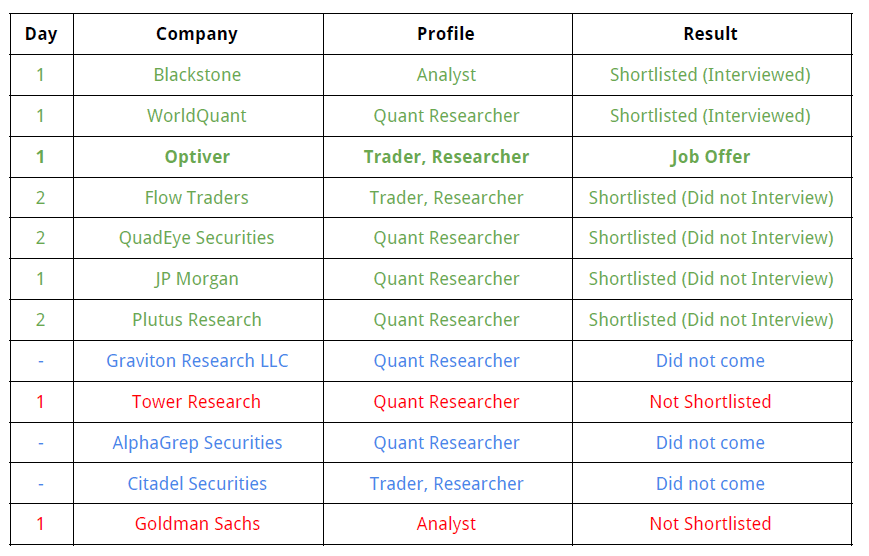
Almost all my tests went well, and with the exception of 1-2 companies, I got shortlisted in almost all of them. The test for WorldQuant was brilliant, with fixed time limit for each question, and the question themselves were excellent. I had a good time giving the test. I felt quite stupid in the tests for Tower and Goldman Sachs, since they asked coding questions and having not prepared anything for coding at all, I could not solve those relatively simple questions, and to no surprise I wasn’t shortlisted in them.
One advice to all candidates would be to prepare, at least till an intermediate level, for algorithms and data structure questions, even if you won’t be sitting for Software. It keeps the mind sharp, and is always useful.
Another test which I found super fun was that of Optiver. It was divided in 3 parts, and tested a lot of different skills. The test for Flow Traders was similar, and I did well in both. For all other Quant Researcher profiles, I found my preparation sufficient enough and was able to clear the tests.
The test for Blackstone was fun as well. They taught us basic accounting in their ITS, and questions were limited to what was taught. Quick calculations and approach was tested, and it went decent for me.
Group Discussions
I only had one group discussion, which was for Optiver. It was basically a market making exercise, and they had given us a document from which we were supposed to read and prepare. I prepared with two of my friends, at 2 separate occasions, and was comfortable with the market making game. The GD went well, although I later realized some of the mistakes which I had made, and I got shortlisted for the interviews.
Day One
I did not sleep well, and waking up at 6 hardly helped the cause. However, the insane rush of adrenaline and nervous energy was more than enough to keep me going. Suited up, clean shaved for the first time in my life, I was ready to be “an adult”. I had 2 companies in Slot 1 and 2 companies in Slot 2, and I absolutely wanted to crack a job on Day 1 itself.
Blackstone
Blackstone interviews are a different beast. I had 3 interviews in quick succession, two by Managing Directors, and one by an associate. The 2 interviews by MD’s were stressful, and they really were thorough with the HR aspect. Both the interviews involved a small case, and mostly HR questions. The third interview was some calculations and HR again. They told me that they had found a better candidate, and somehow I did not fit in, so my chances were bleak. So I decided to give it my all to the second company, which is WorldQuant.
WorldQuant
WorldQuant interviews are the antithesis of Blackstone interviews, at least for me. The atmosphere was so chill, the interviewers were so chill that I instantly felt at ease. I had to give 5 interviews for WorldQuant, and with the exception of 1, all others were technical interviews with the interviewers grilling about my resume, my research, asking a lot of puzzles and probability. Having prepared well, I fared well, and I felt I had a good chance to bag the job. The results would be out by the night, and I would know how well I had done.
Slot 1 was done. I went back, had a good lunch and slept for sometime, knowing that the battle was still on. I woke up and went back to H16 for Slot 2.
Optiver
Optiver was in slot 2, and the company takes you directly to Amsterdam. I wanted to work in Europe, and the trader profile seemed exciting enough for me to give it my best. Not to mention, the high bonuses (:P). My first interview was a technical one, and boy was it fun! It was a pure skill based, quick math based interview where I had to calculate a lot of things quickly in my hand. There was also a super interesting puzzle which they gave. I could solve that puzzle, so I felt pretty good about my chances. The HR interview went pretty well, and I was called for a third interview, this time for the research profile. It was 10 PM in the night, and my mind was on the verge of collapse. I was not thinking quick enough, and although I did okay, I felt I had bombed the interview. The interviewer let me know that it was a negative for the research profile, and that I had to wait for the results for the trader profile.
This meant a nervous 3-4 hour wait, and to add to the tension, they told me that I might be called for another interview at 1 AM. I went back to the room having skipped the JP Morgan profile completely, since I felt I had good chances at WorldQuant. I ate the dinner, and having been completely exhausted, it was a pretty nervous wait. I got a call at 12:45 AM that I was called for another interview of Optiver. I dressed up again, and went back to H16.
What happened next is something that I will remember for the rest of my life. I expected an interview, and with loads of caffeine running in my blood, I was ready for it. I went in the room where I had the technical interview, and to my surprise the HR guys entered the room as well. They all closed the room, and instead of an interview, they offered me the job! I came out extremely elated, having secured one of the profiles which I wanted. I went back, completely satisfied with how my placements went, knowing that I am going to Europe in 2019 !
Tips and Tricks to land that dream job!
One thing is clear. Getting the dream job after IIT is not easy, especially with some many students vying for those coveted few positions. Smart work, and being true to oneself can go a long way in simplifying the process. If you don’t wanna do software, or if you don’t wanna do consult, don’t sign the JAF just because everyone else is doing so, or because it pays more money. Being honest about what you want to pursue and more importantly, what skills and the profile you can show during the interviews helps a lot to sound genuine and impress the interviewers more.
Another thing to keep in mind is that despite some people telling that CPI doesn’t matter, IT DOES. There are some profiles such as consulting or trading for which CPI might matter less, but for most of the other roles, having a good CPI gives an advantage over other candidates. Also, it is undeniably true that software roles have a much higher salary than core jobs, with the exception of Electronics based jobs. Most jobs pay in the range 10-20 lakhs, so do not be disappointed if you don’t see those 1cr packages. Salary depends on the place and country you are working, and converting everything to Rupees is a terrible idea.
Before December
● If you are absolutely dead sure that you want to pursue a PhD, do not sit for placements just because you want a job. While it sounds safe, I have seen a lot of my friends focussing on applications because they were sure about their priorities. It is highly stressful, and to be honest, just giving a half-hearted attempt to placements will do you no good.
● Listen well to the PPT’s for the companies you are interested in and be sure to ask about the other side. Most companies only show the good side of the job, and leave out the stress, or bad work-life balance of the job.
● Don’t randomly sign JAF’s left and right, because you want to play it safe. Take some time to figure out the 2-3 profiles which you like and select those companies. In any given slot, only 2-3 companies are possible to manage, hence getting shortlisted for 10 companies on day 1 doesn’t mean anything if you can’t complete the process of even one.
● Prepare well for the tests and take them seriously. Do not rely on the last minute preparation that everyone gets used to in IIT, because it simply doesn’t work.
● If you are weak in the aptitude section, prepare well for it by solving CAT material. Having a good grasp of sequences, probability and puzzles always helps in the interviews.
● For BTechs, it can get particularly taxing, hence remember to choose chill courses which don’t require a lot of assignments or efforts. Towards the end, all the (tests + endsems) can get super hectic, and it is always beneficial to have less academic pressure.
● For Duals, work really hard in the early part of the semester and get your DDP1 done as quickly as possible. October and November are crucial to do well in placements, and no wonder DD students do well in placements, since they have so much time to prepare well.
● Reach out to a lot of seniors who are working in the companies you are interested to join. Talk to them comprehensively and get an idea about what the job entails. Too often, the jobs are not what they seem and this can lead to dissatisfaction.
● Prepare a timetable and stick to it. The placement semester might be the most important semester career wise and be ready to work hard. Slacking off in this semester might prove disastrous! Give it your best because placements only comes once, and the ease of having so many companies coming under one roof is unmatched anywhere else. #NoRegrets
● Be clear about the reasons for joining companies offering profiles which are polar opposites of the profile your resume shows. Being genuine again goes a long way to convince that you want the job and are the ideal candidate
● Spend some time to prepare well for HR questions. This might be easily the most overlooked aspect of placements, and having a good grip on your resume, and your HR questions is crucial to getting that coveted job.
● Fluency in English is a must unless you are brilliant and fit for the profile for which the probability is quite low.
On Placement Day
● Dress well, invest in a good fitting suit, and have good trim of the hair and beard for males, and a good haircut for females. Physical appearance, and the first handshake contributes to the first impression which plays a major role.
● Be confident in all your interviews, and never bullshit or brag about your points. The interviewers have done this too many times, and are aware of the extent of the impact of your intern or POR.
● Plan well for the slots, and keep a friend with you who will coordinate with the company officials (called the “runner”). You are too busy to plan for the next interview, and having a good “runner” is absolutely crucial
● Be smart about your decisions and ensure you give as many interviews as you can for the company you actually stand a good chance for, and which actually show interest in you.
All in all, Placements are an amazing experience, and everyone has something to learn from it. It is highly stressful, and to some extent luck based, but if you deserve a good job and have worked hard to prepare for it, you will end up with something good! Even if you don’t, this job is not gonna be the last one in your career 🙂
All the best!





 Be-Prepared