Avineil Jain

Thought Structuring, Pre-Placement Preparation, Day One, Opitver, General Tips and Tricks, Before December, On Placement Day

Profile at a Glance

Internships:
○ 2nd Year Summer Research Intern at George Washington University (Physics)
○ 3rd Year Winter Intern at Viacom18 (Strategy Intern)
○ 3rd Year Summer Intern at Schlumberger Technology Center (Software, Analytics)
POR’s:
○ Head of the first Data Analytics and Visualization Team of IIT Bombay
○ ISMP Mentor
○ DAMP Mentor
○ Electronics Club Convener, STAB (Now comes under GS Tech)
○ Mood Indigo Convener
● Semester Exchange to National University of Singapore

Thought Structuring and Getting Perspective

I first had to think very seriously about placements because I mostly wanted to go for Masters after IIT and was pretty sure about it. But looking at some of the lucrative JAF’s that opened, I decided to give placements a chance and target specific companies. I spent some time analyzing my strengths and dislikes. I came to the following conclusion
Strengths: Quant, Analytics, Deep Learning and ML, High CPI
Dislikes: Software Development, Core Electrical and Electronics
Weakness : Lack of 3rd Year POR
Thus, it became evident that I had a good chance at the Quantitative Researcher profiles at High Frequency Trading firms, and the analyst profiles of several finance companies. Also, I had a good chance at AI research profiles that opened at the placements. I also felt the peer pressure to apply to consulting companies, just because everyone was applying to them. However, I realized through my talks with my ISMP mentor (who was in consulting for a few years) that consulting is not something that I would want to do, and with a very strong will, I decided not to sign the consulting JAF’s.
I used the technique of elimination to arrive at what profile I wanted to target. Looking at my dislikes, it was pretty obvious I wouldn’t sign any core profile or any software development profile for placements. This eliminated more than 80% of the JAF’s for me. Good. Through my DDP I also realized that I do not possess the skill-set for academic research so a PhD or an RnD profile in a core company was also eliminated. This also meant, that despite my strong profile in ML, I did not sign any lucrative high paying AI RnD positions.
Looking through the various JAF’s that opened, I utilized a strategy that I felt really made my placement process stress free. I only signed JAF’s for the companies which I actually wanted to join. Note that in my case, I had the option of choosing masters as well (since I have a pretty high CPI), so I really wanted to put my efforts to companies for which I would leave masters if I got an offer. This made me only sign around 18-20 JAF’s in total out of which I was serious for only 3-4 companies. I told myself that I would seriously prepare for these 3-4 profiles. Obviously this strategy is not for everyone, but for those who can afford it, this approach will be beneficial. This approach really helped since I avoided giving a lot of tests which get really stressful, and instead gave me time to focus on my DDP and prepare for the profiles I wanted.

Alternatives

As mentioned, there was only one alternative for me. Either an offer from those 3-4 companies, or masters in US. So I also gave GRE and TOEFL in Aug-Sept, and started applications as well. I got 331 in GRE and 118 in TOEFL. I realized that an MBA in India is not something I wanted to do, and so CAT was eliminated from my options. I also did not want to pursue Civil Services at that time, and so that option was out as well.

Pre-Placement Preparation

With the above strategy, all I had to do was prepare for Quant (Probability and Puzzles). I practised it using some textbooks, as well as online sites for puzzles. Turns out, I got shortlisted for Blackstone as well, so I had to prepare for cases as well. Case preparation took a lot of time, and frankly, I wished I had signed for consults just so that I could get more case preparation. I also practised sequences, and quick math for trading profiles.
I took all the tests seriously, and since I had to give so few tests, it meant that I could prepare well for each of them. I also attended PPT’s of companies I was serious about, and talked with some of the employees, since it gave a lot of perspective of whether I actually wanted to work there. The one thing which I really hated about the process was the PPT rule, which meant that I had to waste time and attend PPT’s for companies I did not want to join, just to fulfill the weekly quota.
I would recommend forming a nice case group to prepare for case studies. Often having 2 groups is perfect, since not everyone would be available all the time. Also, just 4-5 days before the placements, sit alone in a room, and really think about yourself for HR. I really had to come up with clear reasons of why I wanted to join a particular company, since I wished to appear genuine and give proper reasons as to why I wouldn’t pursue higher studies.

Tests

Almost all my tests went well, and with the exception of 1-2 companies, I got shortlisted in almost all of them. The test for WorldQuant was brilliant, with fixed time limit for each question, and the question themselves were excellent. I had a good time giving the test. I felt quite stupid in the tests for Tower and Goldman Sachs, since they asked coding questions and having not prepared anything for coding at all, I could not solve those relatively simple questions, and to no surprise I wasn’t shortlisted in them.
One advice to all candidates would be to prepare, at least till an intermediate level, for algorithms and data structure questions, even if you won’t be sitting for Software. It keeps the mind sharp, and is always useful.
Another test which I found super fun was that of Optiver. It was divided in 3 parts, and tested a lot of different skills. The test for Flow Traders was similar, and I did well in both. For all other Quant Researcher profiles, I found my preparation sufficient enough and was able to clear the tests.
The test for Blackstone was fun as well. They taught us basic accounting in their ITS, and questions were limited to what was taught. Quick calculations and approach was tested, and it went decent for me.

Group Discussions

I only had one group discussion, which was for Optiver. It was basically a market making exercise, and they had given us a document from which we were supposed to read and prepare. I prepared with two of my friends, at 2 separate occasions, and was comfortable with the market making game. The GD went well, although I later realized some of the mistakes which I had made, and I got shortlisted for the interviews.
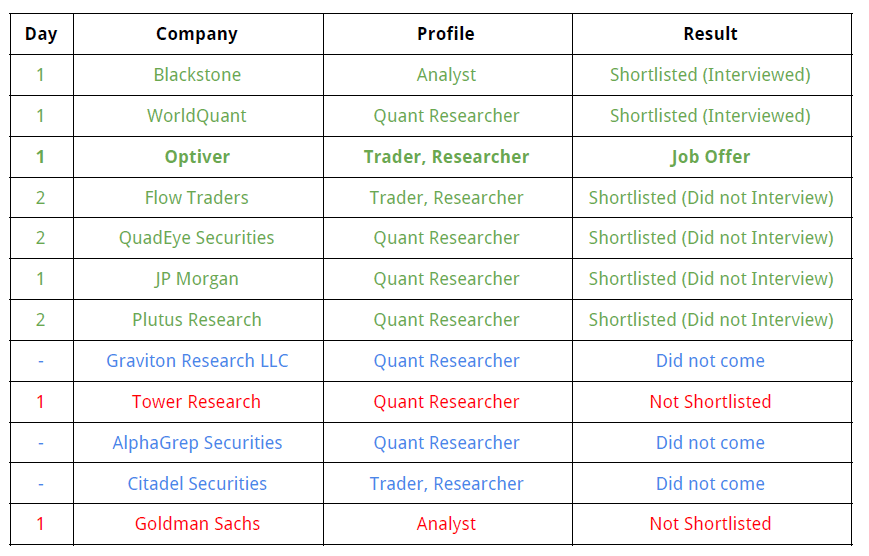
Day One

I did not sleep well, and waking up at 6 hardly helped the cause. However, the insane rush of adrenaline and nervous energy was more than enough to keep me going. Suited up, clean shaved for the first time in my life, I was ready to be “an adult”. I had 2 companies in Slot 1 and 2 companies in Slot 2, and I absolutely wanted to crack a job on Day 1 itself.

Blackstone

Blackstone interviews are a different beast. I had 3 interviews in quick succession, two by Managing Directors, and one by an associate. The 2 interviews by MD’s were stressful, and they really were thorough with the HR aspect. Both the interviews involved a small case, and mostly HR questions. The third interview was some calculations and HR again. They told me that they had found a better candidate, and somehow I did not fit in, so my chances were bleak. So I decided to give it my all to the second company, which is WorldQuant.

WorldQuant

WorldQuant interviews are the antithesis of Blackstone interviews, at least for me. The atmosphere was so chill, the interviewers were so chill that I instantly felt at ease. I had to give 5 interviews for WorldQuant, and with the exception of 1, all others were technical interviews with the interviewers grilling about my resume, my research, asking a lot of puzzles and probability. Having prepared well, I fared well, and I felt I had a good chance to bag the job. The results would be out by the night, and I would know how well I had done.
Slot 1 was done. I went back, had a good lunch and slept for sometime, knowing that the battle was still on. I woke up and went back to H16 for Slot 2.

Optiver

Optiver was in slot 2, and the company takes you directly to Amsterdam. I wanted to work in Europe, and the trader profile seemed exciting enough for me to give it my best. Not to mention, the high bonuses (:P). My first interview was a technical one, and boy was it fun! It was a pure skill based, quick math based interview where I had to calculate a lot of things quickly in my hand. There was also a super interesting puzzle which they gave. I could solve that puzzle, so I felt pretty good about my chances. The HR interview went pretty well, and I was called for a third interview, this time for the research profile. It was 10 PM in the night, and my mind was on the verge of collapse. I was not thinking quick enough, and although I did okay, I felt I had bombed the interview. The interviewer let me know that it was a negative for the research profile, and that I had to wait for the results for the trader profile.
This meant a nervous 3-4 hour wait, and to add to the tension, they told me that I might be called for another interview at 1 AM. I went back to the room having skipped the JP Morgan profile completely, since I felt I had good chances at WorldQuant. I ate the dinner, and having been completely exhausted, it was a pretty nervous wait. I got a call at 12:45 AM that I was called for another interview of Optiver. I dressed up again, and went back to H16.
What happened next is something that I will remember for the rest of my life. I expected an interview, and with loads of caffeine running in my blood, I was ready for it. I went in the room where I had the technical interview, and to my surprise the HR guys entered the room as well. They all closed the room, and instead of an interview, they offered me the job! I came out extremely elated, having secured one of the profiles which I wanted. I went back, completely satisfied with how my placements went, knowing that I am going to Europe in 2019 !

Tips and Tricks to land that dream job!

One thing is clear. Getting the dream job after IIT is not easy, especially with some many students vying for those coveted few positions. Smart work, and being true to oneself can go a long way in simplifying the process. If you don’t wanna do software, or if you don’t wanna do consult, don’t sign the JAF just because everyone else is doing so, or because it pays more money. Being honest about what you want to pursue and more importantly, what skills and the profile you can show during the interviews helps a lot to sound genuine and impress the interviewers more.
Another thing to keep in mind is that despite some people telling that CPI doesn’t matter, IT DOES. There are some profiles such as consulting or trading for which CPI might matter less, but for most of the other roles, having a good CPI gives an advantage over other candidates. Also, it is undeniably true that software roles have a much higher salary than core jobs, with the exception of Electronics based jobs. Most jobs pay in the range 10-20 lakhs, so do not be disappointed if you don’t see those 1cr packages. Salary depends on the place and country you are working, and converting everything to Rupees is a terrible idea.

Before December

● If you are absolutely dead sure that you want to pursue a PhD, do not sit for placements just because you want a job. While it sounds safe, I have seen a lot of my friends focussing on applications because they were sure about their priorities. It is highly stressful, and to be honest, just giving a half-hearted attempt to placements will do you no good.
● Listen well to the PPT’s for the companies you are interested in and be sure to ask about the other side. Most companies only show the good side of the job, and leave out the stress, or bad work-life balance of the job.
● Don’t randomly sign JAF’s left and right, because you want to play it safe. Take some time to figure out the 2-3 profiles which you like and select those companies. In any given slot, only 2-3 companies are possible to manage, hence getting shortlisted for 10 companies on day 1 doesn’t mean anything if you can’t complete the process of even one.
● Prepare well for the tests and take them seriously. Do not rely on the last minute preparation that everyone gets used to in IIT, because it simply doesn’t work.
● If you are weak in the aptitude section, prepare well for it by solving CAT material. Having a good grasp of sequences, probability and puzzles always helps in the interviews.
● For BTechs, it can get particularly taxing, hence remember to choose chill courses which don’t require a lot of assignments or efforts. Towards the end, all the (tests + endsems) can get super hectic, and it is always beneficial to have less academic pressure.
● For Duals, work really hard in the early part of the semester and get your DDP1 done as quickly as possible. October and November are crucial to do well in placements, and no wonder DD students do well in placements, since they have so much time to prepare well.
● Reach out to a lot of seniors who are working in the companies you are interested to join. Talk to them comprehensively and get an idea about what the job entails. Too often, the jobs are not what they seem and this can lead to dissatisfaction.
Prepare a timetable and stick to it. The placement semester might be the most important semester career wise and be ready to work hard. Slacking off in this semester might prove disastrous! Give it your best because placements only comes once, and the ease of having so many companies coming under one roof is unmatched anywhere else. #NoRegrets
● Be clear about the reasons for joining companies offering profiles which are polar opposites of the profile your resume shows. Being genuine again goes a long way to convince that you want the job and are the ideal candidate
Spend some time to prepare well for HR questions. This might be easily the most overlooked aspect of placements, and having a good grip on your resume, and your HR questions is crucial to getting that coveted job.
● Fluency in English is a must unless you are brilliant and fit for the profile for which the probability is quite low.

On Placement Day

Dress well, invest in a good fitting suit, and have good trim of the hair and beard for males, and a good haircut for females. Physical appearance, and the first handshake contributes to the first impression which plays a major role.
Be confident in all your interviews, and never bullshit or brag about your points. The interviewers have done this too many times, and are aware of the extent of the impact of your intern or POR.
● Plan well for the slots, and keep a friend with you who will coordinate with the company officials (called the “runner”). You are too busy to plan for the next interview, and having a good “runner” is absolutely crucial
● Be smart about your decisions and ensure you give as many interviews as you can for the company you actually stand a good chance for, and which actually show interest in you.

All in all, Placements are an amazing experience, and everyone has something to learn from it. It is highly stressful, and to some extent luck based, but if you deserve a good job and have worked hard to prepare for it, you will end up with something good! Even if you don’t, this job is not gonna be the last one in your career 🙂

All the best!

Vibha Talwar

Sectors to Target, Resume, Placement Preparation, Experience

There are certain bullet points which you have to keep in mind during placements:

  1. This is not only your knowledge test, but a test of your overall skills, be it academic, be it personality wise, be it your emotional skills, so you need to be mentally and emotionally strong as well, if you’re, half of your job is done.
  2. Yes, you need to work. No matter how good you are, without hard work, it’s difficult to survive and get something positive
  3. I’d like to correct the hard work and would say you need to do smart work as in less time, you’re going to do much more.
  4. You need to be aware of the things, e.g. some people won’t know that there is a
    placement group across all IITs where certainly you get to know about tests happening and it’s content as well, sometimes. Constantly be in touch with your immediate seniors.
    Have good friends to prepare with. You need not have a fixed group.
  5. “GIVE UP” should not be in your dictionary for this complete while.

Sectors to Target?

I decided to go for finance and consulting. But somehow basic analytics which does not include machine learning, NLP, etc. is covered in the preparation for above. I was midway being distracted by the coding profiles as well, as I have the interest in coding as well but that should not be the case. Prepare well for the chosen ones and if you want to, you may go for at most 3 fields. This is what was suggested to me by my seniors and I would say if you follow the timeline provided, you would have sufficient time to prepare for 3 profiles efficiently and easily.

Start Preparing, but When?

There’s no fixed time. You’d be provided certain ideal timelines to prepare by your seniors. Honestly, I was curious during my summers only and I just saw what all was there in timeline but I never followed it. I was far behind it. I’d say if you follow that, you’ll have more time to do things and you’ll be less panicking and will be ready with more content for sure. So try and follow it. Do start collecting material in summers.

Resume

YES it is very important. Start in you summers itself. It’s the thing one is going to have look just for less that 30 second and you have to make a good impression to the person who is shortlisting. Just put in the things you did with numbers, this is the most important tip. Your resume should be impactful. When you’re getting it reviewed by seniors, do multiple sessions of reviewing but make sure you listen to all but follow upon which looks genuine and correct according to you, as you can not act upon everyone’s advice. I made 2 resumes- one for consult which included more of leadership qualities and one for finance which included some tech and coding. Totally depends upon you. But some people waste a lot of time on making resume.
Don’t do that. Start as soon as possible, get it reviewed and make changes. Repeat the process for 5-6 times. That’s more than enough. Don’t bluff with the resume because you have to submit proofs and checking is definitely stricter.

Placement Preparation

First, go and check out on previous year blog, who all are the people being shortlisted in the companies you are aiming at. Talk to them. You really need to talk to them. Ask them about the test first and then further if shortlisted. Tests and all will start from October end, it depends upon PT cell.
For tests, you can look at:

  1. Ask seniors about test patterns
  2. Check Inter IIT placement groups for the previous years as well
  3. Your friends in other IIT
    After seeing this, you’ll have a rough idea what to prepare in apti. Pariksha seemed easy to me as compared to some company’s tests, where apti was not that much required. You need speed, accuracy. Pariksha tests will help you definitely and do a bit high level as well. E.g. Mastercard test was at higher end in difficulty.
    Do puzzles from brainstellar. Puzzles are ASKED in test as well, like FinMechanics, JPMC.
    Probability puzzles are must. Practice as much as you can.
    Do everything daily in a time frame. Start watching victor cheng videos.
    For finance, I did nothing as such, except doing some institute coding challenges and reading the book- Day one.

my first shortlist was Nomura Consulting, which gave me a lot of confidence. Honestly, I did not expect but anyhow this was a golden opportunity for me as I was interested in consulting. Everyone was being shortlisted and I was seeing many many repeated names and wasn’t finding mine. I was hardly shortlisted for 7-8 companies who were visiting the campus till Day 3 Slot 1. That might seem good number to many but NO, it wasn’t. As 3-4 had selected everyone who filled JAF and their first round was GD. Proper shortlisting if I say, was just for 3 companies I think, Nomura, SAP labs, ABInBev. I wasn’t shortlisted for any of the Day 1 company and thus had no
interviews on Day 1. This worried me for sure, seeing everyone getting placed and here I am sitting preparing and not at all sure what is going to happen. In day 2 slot 1, I had one shortlisted company- Nomura and 2 GDs- Exxon Mobil and Alvarez and Marsall. I never never expected I would clear GD rounds and to my amusement, I did for both the companies.

Placement Experience

  1. Nomura- They’re very unconventional people. Like more of jolly nature people.
    Interactive ones. First round- I was being questioned from resume only, e.g. they
    combined things and asked me, blockchain technology in supply chain, being a
    consultant what do you think? How can it be used. Rest they asked me to walk through my resume. Some HR questions, why I did this or that? Rapid fire, like leadership or team member? Questions like these. Then there was a case, client is an IAS officer, Narendra modi asks him to promote Hindi as a language, being a consultant help your client suggesting ways how would it be done. Then a guesstimate, number of traffic signals in a city, let’s say Delhi. Second round was a little bad one as they already had their selection before interviewing me and this does happen in interviews, so make sure you’re okay with it and do well. Second round, they were not much active and certain questions were from resume only, like explaining what I did in internships, why Nomura, one guesstimate- number of people wearing optical glasses.
  2. Alvarez & Marsall– GD topic- Impact of electric vehicles on economy. First round- walk me through resume. One guesstimate- market size of small packed fruit juices. Second round- walk me through resume. One market entry case- entry of a school in new place. Standard format. They look upon how much diversity is being included in your case being solved, parameters which have to be checked upon.
  3. Exxon Mobil– GD topic- something related to knowledge or values. I don’t remember exactly. Only one round- Resume. Toughest walk me through resume it was. They asked everything from resume. I would not say it was technical. It was more of things you should know from your resume and the current position of it too, e,g, I mentioned about cement industry in my resume and they asked me about the prices of it and I knew it has decreased but the reason why it happened and the current status of it, they did look for it as well. How much the person is up to date and how much genuinely the person is into things which he or she did in internships majorly and somewhat POR (not that focussed). I was asked about PLC as it was mentioned in my resume, so they majorly question you around your resume only. They would also try to build pressure certainly by forcing you to go for other field but you should have all HR questions prepared to answer them well. (know little bit about company) See, what happens, happens for good and it happened in my case. Profile being offered by Exxon Mobil really interests me and it’s a perfect mix of chemical with management. So, not having much shortlists or having many doesn’t depict your status of placements.

Probably, this was not detailed as I have not included HR prep, GD prep and Resume prep things. This should be a focus to a great extent as per my view. For more prep tips, do contact me and I would be more than happy to help.
At the end, it’s one of the amazing experiences and the most learning one as well in the institute. So, don’t get burdened by it, instead stay calm and keep working. 🙂

Taveesh Garg

Step 1: Sectors to target, Step 2:Resume Making, Step 3: Placement Preparations, Step 4: Signing Companies, Step 5: Buddy Programs, Step 6: The Final Day

Profile at a Glance

● Academic:
○ Department Rank 3 in Chemical
○ Institute Academic Prize
○ Minor in Management
● Internship: Supply Chain Role at Procter & Gamble; worked with Gillette
● Leadership Roles:
○ Events, Student Alumni Relations Cell
○ Team Member, Alumni Student Mentorship Program
○ Teaching Assistant, BB 101 course
● Core Projects: Two core projects, more MATLAB and excel based rather than the
application of core concepts.

Placement Experience

The SIX STEP Journey

STEP 1: Deciding the sectors to target

I found this step to be one of the most difficult ones. Here, you should decide what all you are going to target in the placement season. Along with sectors, we should also try and decide if we are going to prepare for CAT/GRE etc. We should try to get a clearer understanding of different sectors by talking to seniors already working in those. Browsing previous year’s blogs help a lot.
Though it may look like an easy job to complete, trust me it’s not, for most people. The same was the case for me. So, I took an easier way out. I struck out the sectors in which I don’t want to work for (Coding, Finance, Core) at least at the beginning of my career.
I started preparing for the other sectors (Consulting and Analytics) and planned to cut off one, depending upon how interesting their preparation is and of course, my consult shortlists (I feel preparation and criterion for judging for a job in any sector/firm says a lot about the actual skills you might we using there).

Learning: Introspect which sector/firm you want to work for. Narrow down the list as much as possible. Talking to seniors and understanding different preparations for different sectors will surely help.

STEP 2: Making a Resume

Honestly, your resume has already taken a shape depending upon how you have spent your past 3/4 years in the institute. The easier half is the one to be completed at this step. Generally, people tend to spend A LOT of time making sure they have their perfect resume which defines them. I have a bit of different philosophy. I believe it is not that significant as much people think it is. I am not saying the resume making fundae are pointless but it is definitely not worth spending your day and night of an entire month. Thus, I didn’t brag anything about my work on my resume neither did I use a lot of jargon. Everything which I put up in my resume was only those for which I actually worked hard and things which I was senti about. The advantage it gave me was that I never had to prepare much for the resume as part of interview preparation.
I would encourage and recommend the same as one feel a lot confident in an interview as there is nothing on that piece of paper which you are scared of being asked by the interviewer.

Learning: Listen and understand all the fundae which you get from your seniors about making a resume, but for sure, DON’T write anything which you haven’t done. Try to be as honest as possible and make a resume at the end which you are fully confident about.

STEP 3: Placement Preparation

Now comes the interesting step. I, as mentioned earlier, started preparations for both Analytics and Consulting from August till mid September (time before consult shortlists were out). In Analytics, I prepared majorly for Aptitude and Puzzles.
For consulting, I started the basic preparations with different case groups. Instead of giving Placement Preparations fundae (which you will get a lot throughout the process) I would highlight my learning and experience here. Till the time, I was doing both, I was not performing well at either and took an important decision of just doing consult preparations as I was shortlisted in all Consults. This decision also came out from comparing my interests in both kinds of preparations. After focusing on just consult preparations, I realized my whole process became quite easy and very less stressful, highlighting the importance of finalizing one sector to prepare for depending what you want at the end of the process. After this, Analytics was just a back up for me and I realized I can still do well in this without focusing much, thus finalizing the path of consult preparation to walk on for the next 2 months.

Learning: Finalise a target sector for your preparations. Keep a backup which you think you can handle without putting too many efforts. Don’t take more than 2 preparations in hand.

STEP 4: Signing the Companies

I was very particular about signing any company. I didn’t sign the JAF (Job Application Form) of any company whose work description didn’t seem intriguing to me. Views on this can be very subjective. While some might share the belief with me, while there are who believe to sign as many companies, as it might increase your chances of getting placed. While this belief is true, you must think before signing depending upon the image which you see for your company.
I realized the same when different companies’ tests etc were taking a lot of my time for
preparation and thus in the intent of saving my time to the best extent, I started sitting for only those tests where I can see myself working. I didn’t even sign a lot of D1S1 companies as I knew I wanted consults to be the only target in D1S1.

STEP 5: Acing Buddy Program

These 4 are the major steps in your placement process. I got shortlisted for all 5 Consults and Blackstone. The next challenge in front of me due to so many shortlists was twofold – Handling Buddies from all companies and then deciding “The Company” which is your major target among all these awesome companies, for which you really want to work for, which is closest to ideal image who have in your mind for work, for people and for culture.

A bit brief about the buddy program: This is a program which most of the consulting firms and Blackstone follows under which every shortlisted student is allocated a buddy (someone already working in the firm) to help us out in preparations and to get ourselves clear about what different firms’ work projects are. Some firms also allocate more than one buddy, generally, the second buddy is someone more senior in the firm because he might show us the picture of the firm which the Junior buddy might not be able to.
During the second half of October, your major consult preparations happen through your cases with buddies. You do give each buddy a fair amount of time because of 2 reasons, one, you actually want to learn as much as you can as these are the people who sat through the same process in recent years and have cracked those companies which at this point you are just dreaming of, two, these buddies are your major source to get to know about the company, what projects a particular company is currently doing, what their expertise is and how they are different from the other companies.
My first challenge, handling so many buddies, was obviously tough, but much more insightful. I can easily say if there wouldn’t have been some of the buddies I had, I wouldn’t have able to crack. Talking about the second challenge, choosing “The Company”. This part was actually a lot tougher, for me, personally. I was pretty clear which Consult I want to work for, but wasn’t sure about Blackstone. So, to get myself I talked to a lot of senior people from Blackstone and sat and tried to match what I want at this point in my career and what both companies, Bain and Blackstone were providing. Both companies have their own perks and one has a very different experience in working in both, but as I told earlier, Bain resembled much more to the image of the company for which I would love to work for, thus finalizing my preferences.

Learning: Interact with buddies honestly to learn to the maximum extent possible to learn about the firm and preparations. Finalise your major target company in case of multiple shortlists.

STEP 6: THE FINAL DAY

You are officially allowed to interview only for 5 companies in a particular slot. I chose mine. I had six interviews on Day 1 and finally getting an offer from Bain and Company I closed the process. All 6 interviews were a mix of HR and Cases. Sharing what exactly happened in the interview is of no use I believe, rather I would share the mantra which my buddies suggested to perform your best. The only thing you need with you on that day is your confidence in yourself and calmness. Once you are calm and confident, interviews are super chill!

For any doubts, feel free to drop an email on taveeshgarg@gmail.com

Varun Sant

Pre-Placement Preparation, Resume, LEK, Key Takeaways

Pre-Placement Preparation

There will be different aspects to your preparation based on the companies you wish to apply for. We’ll go over each of them briefly –
1) Mental math –
a) A very important aspect of preparation for majorly trading firms and consults.
b) Do not take this lightly because no matter how smart you used to be you would’ve lost practice due to over dependence on calculators
c) You can use sites like rankyourbrain for this. Desired speed should be around 40 questions (2 min) in hard mode.

2) Aptitude –
a) You will have to be very good in this as most companies will test this.
b) Ensure that you minimize any mistakes
c) Tests on Pariksha.com and the ones conducted by department placement coordinators should give you a good level of preparation.

3) Current affairs –
a) It is important to be up to date with this aspects for GDs and interviews
b) Subscribe to a newspaper – I recommend Hindu and Mint, or read regularly on the app

4) HR and Resume preparation –
a) This part should take around 3-4 days. It can be done close to placements.
b) Be prepared for every single line that you write on your resume
c) For HR, I would suggest sometime when you are alone reflect on your life. Think about all the experiences that you faced at some point in your life which contributed to making you who you are today. This is especially helpful for any unexpected/unprepared questions during the interview.

5) Consult Prep –
a) Attend case interview workshops which will be conducted by the different firms.
b) Focus on quality and not quantity. Over preparation is very real – too many cases and you may become very dependent on your frameworks. This will make you less coach-able.
c) After doing 5-10 cases revise your cases and try to reduce recurring mistakes in the next cases.
d) The cases you will face in interviews will be unlike any you have prepared for so try to do many unconventional cases
e) Take buddy sessions very seriously and show progress across your sessions. Try not to worry about if your buddy is judging you during the process.
f) Towards the end do cases with unknown people rather than your case group or friends. This can do wonders to your confidence ahead of day 1.

Resume

1) Familiarize yourself with what is a resume –
a) Glance through resumes of seniors to understand types of resumes (1 page and 2 page (Consult, Analytics, Finance within 1 page)
b) Notice the formal ways in which points will be written
c) Understand different ways to write same points across 1 page and 2 page resumes

2) Gather information
a) You would have done it for your third-year resume but sit down and write everything you have done in your life. Ensure you don’t miss anything.
b) Try to group all your achievements in headers. You can use existing ones or make your own

3) Making your resume
a) Think of an appropriate format to make your resume table format or header format) based on the matter you have and companies you plan to apply for
b) Pay very close attention to language and formatting – if caught can be a huge turn-off

4) Reviews
a) First round of reviewing should be done by your close friends
b) Second round of reviewing to be done by seniors who have been placed in firms you wish to apply for. Make sure you give them at least a week to review it as they will be pretty busy
c) A continuous round of reviewing to be done by people who you can blindly trust – family or very close friends

5) Miscellaneous
a) Most importantly NEVER lie on your resume
b) Make notes while making your resume of the different points, which you can quickly glance through during resume prep couple of months later
c) You can make upto 3 different 1-page resumes. If you are keen on a particular company you can try to make one resume specifically tailored to it.
d) Try to be different and original in your resume. You should be proud to show people your resume

I had interviews with the following firms –
1) LEK Consulting
2) Boston Consulting Group
3) ATKearney
4) Strategy&
5) Morgan Stanley Investment Banking

LEK Consulting:

Round 1: (Approx. 25 min)
We started by having a discussion about my IIT life and my family to help me calm my nerves.
After a brief discussion, we moved on the case.
Case:
Case type – Market entry
Question –
Your client wants to enter the high-school market in your home town and wants your help to estimate the demand and if this is a feasible idea.
Approach – After a few initial questions based on the client, I broke my approach into 2 major parts – Firstly estimating the demand and secondly checking the feasibility of setting up the school based on the demand supply gap.
After I presented my approach to the interviewer, we had a quick discussion on how I would go about doing it and the data that would be required. Post this we closed the case.
Key learnings –
1) Be confident in whatever you say
2) Initial part of the case is key so be exhaustive

Round 2: (Approx. 25 min)
This was my first partner round. We started by having a similar discussion as in the first round and then focused on the mentorship program as I was involved in the same for 2 years. It was just a normal conversation which transitioned into a case.
Case:
Case type – Unconventional
Question –
Your client wishes to increase interest of students in your college in core engineering. What would you suggest him to change.
Approach – After a few initial questions based on the client, I broke down the college life into various stages – Before he chooses his major, First year in college, Corresponding years. I did so as I felt at each stage the factors which would govern his interest in core engineering would be significantly different. After this, I wrote down all different stakeholders involved at each stage (student, parents, faculty, amenities) and relevant factors under each of them.
After I presented my approach to the interviewer, we had a quick discussion on why I broke down the problem in this way and how the different stakeholders are involved.
Post this I felt the interviewer was convinced with my approach and asked me to wait for my other partner round.

Round 3: (Approx. 15 min)
This was my second partner round. In our initial discussion, it came up that I had taught in an NGO in my first year. This led to a discussion on teaching and transitioned into a case.
Case:
Case type – Unconventional
Question
– How will you implement technology to help teachers to make teaching a more enjoyable experience.
Approach – I broke down my approach into the different stages in delivering a lecture inside and outside the classroom.
Briefly after the interviewer understood my approach we discussed where and how we could implement technology at all the different stages.
Post the interview, I knew that this was going to be my final round irrespective of the result and so I was mentally preparing myself to interview with the next firm if I needed to. Fortunately, after a few minutes the partners entered the room and offered me the job. I accepted the offer and exited the placement process.

Key Takeaways:

1) Be confident – This can’t be emphasized enough. Know that you have done a lot of preparation and that you are ready for whatever happens that day.
2) Always have a smile on your face.
3) Have a trusted friend with you to manage your interviews and trust him completely to schedule your interviews. Do all your thinking only inside the interviews.
4) The entire process will at times be exhausting and scary. It is important to keep going no matter what happens.

Sarvesh Hire

Pre-Placement Preparations, Resume, HR, Group Discussions, Hitachi, Placement Experience

Resume at a Glance:

  • Department: Electrical Engineering (Dual: CSP)
  • Internships
    • 3rd year Summer: TCS R&D Bangalore (IOT, Communication, C++)
    • 3rd year Winter: SmokeScreen Technologies (Cybersecurity, Python)
    • 2nd year Summer: Interface Design Associates (Microprocessors(TI), Embedded C)
  • One page resume projects:
    • Machine Learning: Supervised, Unsupervised learning projects involving classification and clustering as well as a term paper on visualizing features in CNN.
    • Speech processing: digit recognizer
  • POR
    • Manager, Aeromodelling Club, STAB ( Institute Technical Council)
    • Teaching Assistant
  • Extra Curricular Activities
    • Athletics GC(2 bronze) – 2nd year
    • Swimming GC (silver) – 1st year
    • Swimathon (12hrs-18km) – 1st year
  • Languages/software – C/C++, Java, Python, HTML, VHDL, MATLAB etc.

Pre-Placement Preparation:

I wanted to pursue an MBA so my target was if I get IIMA I would go for it unless I get some very exceptional opportunity at a well reputed company. This very serious preparation for CAT enhanced my aptitude skills a lot. There were ‘Pariksha’ Tests for apti-practice conducted by PT cell, and in most on them I use to land up in top 10. I never went below 20th rank in any of the tests, so my aptitude test preparation for placements went really well.

Companies that require coding:

  • Practice coding from these sites:
    o Geeksforgeeks (good questions)
    o Hackerrank (Insti coding tests and many company tests will be on this platform)
    o Interviewbit (good questions)
  • Data Structures and Algorithms (DSA) is a must if companies require programming. Read the JAF well, you can make out whether they are expecting you to know this or not. Nevertheless, study this well. (I studied mainly from geeksforgeeks, and few stuff from other sources)
  • Practice puzzles. There are standard puzzles that are asked. Try solving on your own to train yourself and whether you improve or not at least remember the tricks in the ones you have gone through earlier.

Finance Companies:

  • Quant questions should be solved at really good speed. Most of them are too easy and so the only deciding factor is the time you take. PRACTICE!
  • Puzzles and probability questions are a must.
  • Solve Logical reasoning and data interpretation sets. Logical reasoning sets are the ones where you have extract the correct information from the given statements which are obviously not direct but twisted. DI sets as the name suggests involves playing with data presented in form of a graph (bar, pie. etc ) and for that you should be really fast with numbers and calculations which comes with practice only.
  • Programming if required will be mentioned in the jaff, nevertheless practice.
    For Optiver and Flow Traders (Trading) Companies– Practice Speed Math. Visit previous year blog posts, they had posted sites and types of questions.

Communicate with your friends in English as much as you can. Even the most fluent ones have issues during the tests or interview due to pressure, forgetting basic grammatical rules .etc. If you are someone who already has issues, I would strongly recommend you to give a major emphasis on this. Even if you are technically sound, not knowing English won’t fetch you a job and also grammatically wrong English as in some very serious blunders can create a negative impression.

Group Discussions

For GD, you require some decent knowledge level, hence read newspapers, articles .etc. I made it a point to read newspaper/ articles every morning after breakfast for my CAT preparation but it helped me in placements as well.
Also learn to speak up, don’t just sit there waiting as no one is going to ask you to speak. Also don’t keep on speaking too much and cutting/interrupting someone while they are speaking, it doesn’t go in your favor.
If you are to counter someone wait for the person to finish then do it, also do it in a sophisticated way using your counter-point, don’t be rude or insulting to anyone and even if someone does, never lose your calm.
If possible try to begin or summarize, try to establish a basic context as in what area specifically is the group going to discuss. If it appears that you are making come crucial contribution in establishing the premises and prior clarifications with the group that goes in your favor.
Also if you have made a good point, don’t stop there, wait for some time and speak up again. You don’t want the person reviewing to forget you, they should remember you for making good points and participating actively.

Resume

DO NOT WAIT FOR THE PLACEMENT ORIENTATION (Aug 1st week), START WORKING ON YOUR RESUMES EARLY ON.
Whatever the deadline is, 2 weeks prior to that keep your resumes ready. I made a mistake as I had finished my resume very late (5 days before deadline).
After resumes are ready you have to send your resumes to your seniors to get them verified. Select good seniors, not only based on their company but based on whether they actually had to work on their resume or not and whether they will correct your minute details.
Although many people would advise you to send it to as much seniors as you can, I would suggest to send it to few trusted people (5-6) as sometimes too many conflicting opinions can be a problem as well.
Hence finish your resumes two weeks earlier as you will most probably make lot of changes after inputs from other people and also seniors may not be available for few days which happened with me as I had finished 5 days earlier.
After verifying and making changes and submitting the resume I realized I had a minor typo in one of the resumes along with incorrect selection of some words.
Luckily we were allowed to edit such typos at the time of resume verification. But still that was pretty careless on my part. Hence get it done early and proof read all your versions as many times as you can.

HR

Write down basic points somewhere and practice it (if possible look in a mirror and smile while talking, look happy 🙂 )

  1. Tell me about yourself.
    1 – 2 min max. Don’t tell your entire life story, be as crisp and relevant as you can. Say your name, where you are from, your dept., your interests, key internships and projects (try keeping it relevant to the company requirements), some major achievements, hobbies. They might stop you in between which is completely fine, as long as you haven’t gone beyond 4-5 mins.
  2. Why this company/ What do you know about the company
    Do thorough company research and their projects. For Hitachi Japan, I had spent 2 hours specifically for preparing this question.
  3. Long term and Short term Goals/ Where do you see yourself after five years
  4. 5 strengths and weaknesses
    Strengths- Everyone answers this well. But again, don’t brag too much.
    Weakness- Don’t speak you heart out. Even if the interviewer talks very friendly, don’t! (for eg. Don’t like waking up at morning, have anger issues, poor English, can’t work for long hours .etc.) Try saying something which looks decent. One I had prepared was, I am too critical about myself, even if I achieve something. I feel I could have done better and assess what I did wrong or how it could have been improved. While this keeps me hungry for more, it’s also important to take a moment for yourself and enjoy that. Also mention how you are working on that weakness. In my case I mentioned a good previous achievement and said the above stuff.
  5. If it’s a Japanese company, why Japan?
    Praise culture, people, technologically advanced country, safe, beautiful place.

I was shortlisted for the following interviews:
Qualcomm , TI, Intel, Hitachi Japan(2 Jaffs), Mercedes, Jaguar Land Rover, Hyundai, Societe Generale, Citrix, KLA-Tencor, Morgan Stanley(WL), ICICI(WL), HSBC Global, ISRO .etc.

Placement Experience

Day 1 Slot 1

Qualcomm

This was my first interview of the season and it didn’t start at all the way I wanted to be. The interviewers went too deep, literally asked to solve problems on paper which we did in the third year EE328 exams. I had a very hard time recollecting all those things, as such deep questions were completely unexpected by all of us. From my JAF only one person was selected. That interview was just really bad and my confidence just went down to zero.

Texas Instruments

Same slot, next I was interviewed by Texas Instruments. This interview wasn’t as bad as Qualcomm but my confidence was affected by my previous one. That was perhaps my mistake. Hence as I said before forget all your bad experiences in that room itself. Correct your mistakes but don’t think about the previous one.
That was all for the day, I came to my room and slept till night. Again that was my mistake. Just because couple interviews go bad and that too on first day doesn’t mean it’s bad. I had many shortlists for interviews and plus getting a job on day 1 is not at all easy. I backed myself up and started preparing for Intel and Hitachi the next day.

Day 2 Slot 1:

Intel

This interview was really good. It was good till this extent that the interviewer asked me whether you are targeting some other similar companies and if we select will you join and things like that which gave very positive signs. But this company has a very weird way of conducting interviews. They had shortlisted over 100 people for interviews and very few panels (4-5) were there. People waited from 8 in the morning until 4 in the evening just for that one interview. The arrangement made by the company was pretty much random. It was kind of unexpected that I didn’t get selected for this profile and that too after hearing such positive feedbacks. I didn’t knew the results until 9pm but I was happy that at least the interview went well, and my confidence was back for the next slot.

Slot 2: I was scheduled for Hitachi and Mercedes, but I went for Hitachi first as this was my target company and also I was shortlisted in 2 JAFs for Hitachi. Try to go as early as possible, if you are late, i.e if you are interviewed at the end after everyone, it can affect your chances.

Hitachi Limited

After my Intel interview I had prepared really hard for this one. I studied every small thing, right from the company’s founder, revenue, CEO, no. of employees, profits, to their services, products. etc. For any Japanese interview, always prepare this very standard question ‘Why Japan?’. I focused on very minute details like you are supposed to knock exactly thrice on the door and say nothing. They ask you to come in. I greeted them with a bow. There are specific angles with which you should bow, I had practiced that as well. They look really happy and impressed after I did that.
Sit very straight with your hands on your knees. Also remember they can’t speak/understand English well, hence listen to them calmly and answer them slowly pronouncing each word very clearly. Also while leaving I bowed, they did as well. I feel most Japanese companies decide based on resume which student to recruit prior to the interview, as my interview lasted for only 10-12 mins, after that they asked me to go the HR guy who was in other room. Also Japanese companies generally tell beforehand if they are recruiting either directly or indirectly and also discuss salary details, place of posting as well. Entire thing was over in 20 mins, we clicked a picture (HR guy was just too chill), and well I was the happiest person in the building at that moment.
Everything just got over in a flash and trust me guys you will really feel that lowering of burden once your name appears in the selections list on the blog. I remembered all the worse conditions where I was managing my DDP final presentation, CAT exam due 2 weeks, and continuous tests everyday (from 6:30 AM till 2-3 AM) and next day again the same in sleep deprived and starved condition, every single thing just payed off. It always does sooner or later, no matter what happens, never stop believing in yourself.

In case of any doubts, you can always contact me, I would be happy to help. All the best!!
Sarvesh Hire
hiresarvesh@gmail.com

Sachin Goyal

Why Placements and not Masters? , Coding Tests, SOP for Japan, Placement Experience, General Fundae

Profile at a Glance

I am Sachin Goyal, UG in the Electrical Engineering department. I hail from the city of Udaipur. I have been intrigued by areas of Image Processing and Computer Graphics. I like to explore statistical and mathematical aspects of problems and combine modern approaches with classical solutions to solve research problems.

  • 1 Research paper in Medical Image Processing
  • 2nd year Intern – Johns Hopkins University
  • 3rd year Intern – Qualcomm, Hyderabad
  • 1 other major project

I got shortlisted for Microsoft, Tower Research, Sony Japan, Honda, Samsung Bangalore, Softbank and Hitachi Limited.

Why Placements and not Masters?

Truly speaking, I spent the whole time from semester start (mid July) to midsems ( mid September) in figuring out whether or not to apply for masters. Nevertheless, I started preparing for GRE and TOEFL (took 1 month to prepare). My reason to opt for placements was that I felt I need a break for academia at least for an year or so after my B.Tech. I started feeling too much fatigued from continuous hard work and projects. Apart from this another major reason to choose for placements was that I felt having an industry exposure would help me a lot to decide what actually I want to do in my masters/PhD in future. Having an industrial exposure surely helps one to gauge where the market and technology sector is heading towards in future and hence will help you in proper planning of your graduate studies. Many people may disagree with me on this, but in the end it is you who has to decide. Remember, graduate studies need a lot of devotion and you have a lot of responsibilities also thereafter. Hence you need to be sure of your commitment before opting for masters.

PLEASE JUST DON’T GO FOR HIGHER STUDIES BECAUSE YOUR FRIEND IS ALSO GOING OR PEER PRESSURE.

Coding Test Preparation

I was good in basic coding concepts and knew syntax in C++ and python since I had completed my CS minor and had taken 2-3 CS courses every semester. Being from electrical department also aided. But you need to prepare for Competitive Coding for placement tests.
Mostly the test comprise of 3 algorithms/data structure based questions which you need to solve in 1 to 1.5 hours on coding platforms like hackerrank or hackerearth.
I referred mainly to Geeks for Geeks SudoPlacements course and InterviewBit for coding
preparation. These 2 website would serve more than enough. Also, you will get numerous blogs on web which will guide you properly for coding test preparation.

SOP for Japanese Companies

IIT Bombay is fortunate enough ( and probably the only IIT ) to host 6-7 japanese firms in the
placement season. Companies like Honda, Sony, NEC Japan, Hitachi, Murata, Softbank, etc
visit IIT-B and offer various exciting roles with decent pay. All japanese firm require the student
to submit an SOP for the recruitment process. Japanese people are quite conservative about
their culture and there country, and hence want to know mainly following things about you : –
1) How much do you know about Japan?
2) Will you be able to adjust to cultural change and mainly the Language Change? Have
you had any such past experiences and how you have tackled the same.
3) How do you plan to contribute to the firm and why do you want to work in Japan.
Be sure to cover these points in your SOP. Try to give a story where you faced such challenges,
maybe one you faced when you went to another country during 3rd year intern, or if you are a
North-Indian and went to Bengaluru/Hyderabad for intern, that too can be counted as one. Remember India is a huge country and you can always build an impressive story. You can also mention the cultural change you faced when you joined your college and met people from diverse backgrounds and languages from all over the India.

Placement Experience

Sony takes one single interview which is basically fragmented into 2 parts – Technical and HR.
The HR starts a time of 45 minutes at the start. The first 5 minutes, HR starts the conversation
and breaks the ice.
Technical:
Next 30 minutes technical team members will take over and ask you about your projects and
your interest. I had applied for Graphics RnD profile and had done 2 projects related to graphics. I explained both the projects to them and was simply cross questioned on those. The Sony graphics team lead was one of the interviewer and he asked me about possible future
work in my project and ideas which I had to overcome the current issues in my implementation. Apart from this, at max he asked 1 or 2 simple questions related to the profile.
HR:
For the last 10 minutes, the HR takes over again. He asked me to describe myself, why I want to join Sony and why Japan. After this he asks some odd questions like are you Vegetarian or Non Vegetarian? Is your family comfortable with you moving to Japan? The interview gets over with HR asking you if you want to ask any questions. I would suggest you guys, always be prepared (:P) to ask at least one question. Maybe some clarification of profile or if you don’t get any, simply ask – What is a normal day at the firm like. At the end of the day, I was notified about my selection at Sony, Japan. One important thing to remember during placements is to
KEEP YOUR CALM. DON’T GET PANICKED. BE CHILL AND CONFIDENT DURING THE INTERVIEW AND TRY TO BE YOURSELF AND NOT PRETEND.

General Fundae:

1) It is a good practice to bend and wish arigato at the start and end of the interview. Watch a youtube video on how to wish arigato (Hello) .
2) Practice speaking in very slow English. Use extremely simple English words in the interview. Listen to what they are saying very carefully, it will be sometimes hard to grasp as Japanese are not well verse in speaking English. Plus there are ascent problems.
3) Never ever point fingers towards interviewers. Keep hand movement limited during the
interview.
4) Ensure to knock the door before entering the room surely.
5) Dress well for the interview.
6) Make them believe that you plan to stay long time at there firm. Japanese people don’t switch firms that frequently. Also try to magnify the company by applauding 1 or 2 of there products which amaze you.
7) Try talk to your friends who have been to Japan on an intern maybe.
Feel free to contact me if you have any further doubts.
Mobile : 7045800371

ではごきげんよう (ALL THE BEST!)

Ritesh Burde

Profile at a Glance

  • Inter-IIT Cricket team 2017
  • Internships at
    • Hokkaido University, Japan (STSI program)
    • Bombay Stock Exchange (Research Analyst)
    • Cogoport Pvt. Ltd (Business Development)
  • Position of responsibilities
    • Institute Student Mentor- ISMP and Department Academic Mentor-DAMP
    • General Secretary- Civil Engineering Association
    • Food and Beverages Manager- Aakaar, Civil Engineering Fest

I was shortlisted for Vedanta Oil and Gas (Cairn India) on day 1. They usually hire people for 3 profiles which are people from Earth Sciences and App Geophysics (not sure about the profile), Operations profile for Chemical, Petroleum Engineer profile for Civil and Mechanical.

Placement Experience

Technical Test-
The test was conducted by Cairn India one day before Day 1. Most of the questions in the test were technical but not related to Civil Engineering as the test for petroleum engineer profile and operations profile was the same. CPI cut-off of 8 was imposed to come out with a shortlist for the test. Being a joint paper for Chemical, Mechanical and Civil; questions were mainly from topics like Electricity and magnetism, Chemical compounds, some aptitude questions basically JEE questions.
Group Discussion-
All the students who appeared for the test had been called for Group discussion round. All the shortlisted Civil Engineering students were made to sit in a single group for the GD process which made it clear that they wanted to select at least 1 person having Civil Engineering background. Our topic for the discussion was ‘Is Management Art or Science.’ People who had put in genuine points and had good conversational skills were sought for.
Interview-
Shortlist for the interviews were out by taking into consideration both the GD and Technical test. I personally think more emphasis was given for Group Discussion. Interviews consisted of 2 rounds namely technical and HR but both the interviews for me were mostly HR
Interview Round-1
The Interviewers were testing me on real-life situations that I would face in the organisation and asking me to cite an example if I have faced such situations in my life. Although the people taking the interview did not seem to be from HR but they knew I wouldn’t have much knowledge about the petroleum industry and maybe that is why technical questions weren’t asked.
Questions like

  1. If you are hired as a PE Engineer you would be in a team who would have greater knowledge than you about the petroleum industry, so how would you cope up with it and cite an example wherein you have thrived in such a situation?
  2. Also, one more example being a PE engineer you would at times have to handle people or say labourers who wouldn’t have much experience into the job. So how would you work with such a group?
    This round lasted for about 40 minutes.

Interview Round-2
Coming into the second interview which was HR round, I think the company had almost had their selections. There was a panel of 4 people out of which 2 were the same from my previous interview while 2 were from HR. Questions were mainly focussed as to know me better as a person and about my family background. But the main thing which I noticed is that they were grilling me through each question and negating each and every answer. Typical questions like who is your idol, what is your family background, why don’t you opt for civil services were asked. This round lasted for about 15 minutes.

General Fundae

  1. Start preparing for aptitude and resume as early as possible (Have these things in mind right from your 3rd year Summers.) These two are the most important things which would help your name be in most of the shortlists.
  2. Don’t get sad and reduce your efforts if you do not see your name in the shortlist released by the companies. Remember Vedanta Oil and Gas came on 31st December to take their test.
  3. Have a group of friends who are utmost serious about their placements. Remember having a good group of friends (not necessarily wing mates) is an important factor. Plan well ahead of time by forming case groups even if you are not shortlisted into day 1 consult firms because many other companies do take case interviews too.
  4. Lastly, have a friend (preferably who hasn’t registered for placements) with you all the time during your interviews just in case if there is any need.

Nirbheek Biswas

Pre-Placement Preparation, Group Discussions, Placement Experience, Interview

Profile at a Glance:

● 3 internships
○ 3rd year summer: R&D at Aditya Birla Group (Grasim)
○ 2nd year summer: R&D and Business Development at Nanologica AB (Sweden)
○ 2nd year winter: R&D at Ultra Pure Analytics
● Activist and Member -Saathi
● Course on Wheels and Second in Regional Stage of Global Student Challenge

Pre-Placement Preparation

I personally had a lot of experience in R&D but was unsure if that’s what I wanted to do mostly because of dismal CPI. I also had a slight knack for finance and wanted to give it a shot but was scared that it might be too late to start. I would advise that you figure out what to do from the start or maybe eliminate the things you are sure you are not interested in. This would make the preparation that ensues less tedious and more organised.
I also started pursuing my passion for fitness more seriously this semester, this helped with the stress and also helped me organize my day slightly better as everything could pivot about my gym sessions. I feel having a hobby could really be beneficial and you would have something else to discuss apart from what is on your resume.
You could easily end up giving close to 50 aptitude tests in a short duration so I kid you not prepping for it as early as possible is the best thing you could possibly do. I was preparing for CAT so that was kind of taken care of, working on speed math and some amount of English would come in handy as well.

Group Discussions

Having a GD group and discussing various GD topics (at least 10) would be the smart thing to do. I made the mistake of not having such a group and would deem myself as lucky to have cleared two rounds of GD, but I wouldn’t lie, I have always had above average speaking skills and I usually don’t get flustered in large crowds.
I started working on my Resume and HR doc around the 27th ( I would suggest you start earlier if possible), ask for help from seniors, your friends and people around you, everyone would have something valuable to offer. Write and rewrite your answers, lie if you must, give as many mock interviews as possible. During the interview I felt confident because I had spent so much time preparing and the stories I was going to tell felt compelling and had meat to them.
Dr. Reddy’s had a pretty long test, they had a core test which was surprisingly quite easy, along with other tests which focused mostly on pattern recognition and completion of sequence, followed by a lengthy and to be honest quite taxing psychometric test. Each candidate had to also submit a 2 minute video talking about what they could offer as a chemical engineer, to my surprise all three people in the panel had seen and could remember instances from the video.

Placement Experience

For me Day 2 Slot 2 was Day 1 as I had zero shortlists on day 1. Slot 2 begins around 6, I had decided to wake up early that day and spent most of my day in solitude, I had mostly stopped looking through my resume and the HR questions and focussed more on get into the right frame of mind. I had promised one of friends a few days back that I would get selected in the first interview I gave and that somehow gave me a lot of positive energy and confidence.

GD Round 1

We got divided into groups of three, each group had 10 individuals, I personally felt that my group was slightly tougher compared to the other 2.
We had been given a brief description of a method to produce nano-particles that could carry an API, followed by a few questions (all related to the engineering aspects of the method) that were given and we were supposed to discuss on those lines. Another thing I noticed was that the adjudicator of the GD was really attentive and made sure each of us got a chance to speak and express our views. We were also given a sheet to sign out names on where the judgement criteria was clearly written and the points for each of those criteria stated individually.
I might have had an edge in the first GD as the topic was quite similar to my work in Nanologica AB, but I decided to keep that to myself and let others decide where the discussion would go. I don’t feel that starting a GD is quintessential but if you do, you should have a clear direction in mind and something valid to speak.
I personally like to take my time to understand the topic and figure out who else is doing well, being courteous and raising your hand whenever you want to express your opinions is usually considered to be a good habit, I also always try to ensure that people get to finish what they have to say and try to correct people as humbly as I could possibly could.
I personally felt that the first GD went pretty nicely and I was quite sure that I would clear the round. I had to wait for a long while to get the result, it helps if you have someone reliable to accompany you and also carry along some food.

GD Round 2

As expected I got selected for the second round, which I felt would be a technical round (had prepared a lot for it) but this was also a GD round. 10 of us got selected, 4 from my group and 3 each from the other groups. This GD started a bit late as we had to wait for a few other candidates who were busy with other interviews, this gave me an opportunity to have a conversation with
the panelists, this was a great opportunity to find out about them and also what they were looking for, I also got to know that after this was the last round which was supposed to be a HR round, this gave me a much needed confidence as I well prepared in my HR preparation.
The second GD was similar to the first one, it was actually the topic given to the third group, I think I struggled a bit in this GD mostly because everyone in this group was quite good and had already cleared one obstacle.

Interview

We later got to know that this GD was conducted to create somewhat of a pecking order, with the ones on the top more likely to be selected.
I was placed third. The guy before me was offered a spot offer so I was a little tensed as I had to live up to the expectations.
The panel had 3 individuals, with mostly one person (technical background) asking the most questions.
The interview started with them asking me about the coat buttons (like should they be open or should they be closed when you sitting etc), I think this was more of an icebreaker and also to see the candidates presence of mind. This was followed by general questions about my internship at Aditya Birla, I was quite confident in my work there so I dwelled into the details of my project.
This was followed with just general questions about my background, people I admire the most, qualities I would like to inculcate, things I’ve learned from my parents. I answered these questions quite comfortably giving them ample examples and instances that have shaped me into the person I am today,the interview ended with me asking them about whether Dr. Reddy’s plans to focus on creating their own API’s in the future and questions about the program that they were offering,the interview was quite short, probably did not last more than 10 minutes.
After this they asked me to leave the room, I knew they had given a spot offer to the candidate before me so I was quite disappointed as I was about to walk out of the room, just as I was about to step they asked me to wait outside the room for a minute, after a quick discussions they called me back in and offered me the job, they asked me specifically that I don’t tell anyone about it.
When I walked out of the room about 10 of my friends had gathered outside and from the huge smile on my face they could tell that I had been given the offer and they ended up creating a lot of noise.
To be honest the fact that the 2 candidates above me in the pecking order had rejected the offer might have helped me in the end. They panel called me again after all the interviews were over, approximately two hours later by then my suit was in shambles and we had a small discussion about the incident that ensued after they gave me the offer. We discussed how I had talked about the importance was honesty in my interview and how I had let them down, I apologised for my behavior and promised that this would never happen again, to my respite this was enough and I was offered the job.
I would like to reinstate that I was quite lucky that I got selected in Dr. Reddy’s, in no other turn of events would I have made it and knowing that probably was a very freeing thought, I was willing to persevere and I feel that is what it boils down to in the end, placements are weird and things happen that you would never expect, all you can do is think of it as one interview at a time and give your best shot.

Naman Kaliswal

Pre-Placement Preparation, Citibank

Profile at a Glance:

Mumbai Suburban Railways Project: Optimization of crew schedules, Master’s Thesis. Proposed the project to Western Railways, got covered in Times of India Edelweiss Financial Services Summer Internship: Worked as an algorithmic trader
Indian Army Project: Analysis of signals from radar to detect non-metallic buried landmines
Entrepreneurial Venture: SaaS platform for complete chatbot management, Won competitions (including Top 5 in Eureka’17, 2nd in Crusade’17), received mentorship from IIT alumni and industry experts
Technical Projects: Machine learning app for non-coders, Ethereum app, IoT Irrigation System, 360° sound generation tool, rating horror movies on heart rate readings
Extracurricular: Teaching Assistant, National Social Services Associate, Hostel Secretary, Anchored multiple events, performed plays, fluent Spanish

Pre-Placement Preparation

 Work on your speaking skills
I believe that this is the most important aspect that can get you a job swiftly. Learning to communicate your thoughts efficiently will help you in all spheres of your life.
 Learn to sell yourself
Remember that the interviewers are humans too. Naturally, they are drawn to stories. If possible, tell the interviewers why you took on a particular project and why is the problem interesting. I believe that this is specifically important for non-core profiles. Interviewers would be more drawn towards your narrations. This paints a picture that you make informed choices and shows you can propose and execute on initiatives.
 Resume Preparation
Be thorough with every point you mention in the resume. Keep in mind that whatever you write in your resume can be cross-questioned. Be well prepared for questions that the interviewer might throw at you. Ask your friends to go through your resume and make them ask you questions. It is highly probable
whatever doubts come up in your friend’s minds might come in the minds of the interviewers.

Citibank

Citibank’s Global Consumer Bank program selects individuals who could work in different verticals of their business. They were looking for strategic thinkers, people with creative ideas and good communication skills.

Round 1: Group Discussion
We were clubbed in groups of 8 and were evaluated by a panellist of 2. There were 2 GDs, each of 10 minutes duration. The topics of the group discussion were:

  1. Structure follows strategy
    The first topic is abstract and loose enough to be discussed from various angles. I would recommend not open/close such topics for the vast amount of discussion scope possible. Discuss the topic with examples. Mention a bit about your experiences or background to support your arguments.
  2. Section 377 in corporate Sector
    Section 377 was in the news, a month before the placements. Being an avid news reader, I had some facts in mind. Highlight the points to be discussed. Relate the topic to other similar events/policies to back up your points.
    Make sure you are being heard. Maintain an eye-to-eye contact with other participants and the panelists. Whenever given the chance to speak, put forth your views completely and at least present 3-4 sentences. Interrupting with a single sentence to add a little point may sometimes seem unnecessary to the panelist. Respect your peers and listen patiently when others speak. Sit in a confident body position.

Round 2: Personal Interview
There were again 2 people taking the interview. The interview was a discussion on the following:

  1. Academic life at IIT, little about personal interests
  2. Dual degree project
  3. Start-up experience
  4. Microsoft Hackathon that I had participated in
    Be cheerful, attentive and confident during the interview. Always be clear with whatever you’re trying to convey. Avoid using technical jargon which the interviewer might not understand. Asking a question at the end of the interview is a good way to show interest.

Harsh Srivastava

Pre-Placement Prep, Placement Experience, American Express, General Fundae

Pre-Placement Preparation

a. I was pretty clear on what companies I’d be targeting, hence figuring out the placement preparation goals was relatively easier.
b. My prep was majorly focussed on practising my coding skills, doing logic and
probability puzzles and learning enough about finance to be able to hold an intelligent discussion in an interview, alongside the usual practise of aptitude tests. I wasn’t really focussing on consulting firms, hence case prep was really not on my radar, which led to a rude shock during my AmEx interview.
c. Towards the beginning of November, I started working on HR questions. Having ready answers to the standard questions of HR interviews is a must and it helps if you have worked on framing answers to questions which are not the usual suspects, since, once in a while, some interviewer will ask you a slightly twisted question and having some extra ammunition comes in handy.
d. Try and find out if the companies you are targeting take GDs. If they do, form a group (with NOT your friends) and get together at least once every fortnight to practise your speaking skills. Even if your target companies don’t take GDs, form a group anyways as the practise would help you keep your thoughts collected and concise even in an environment pregnant with pressure, anticipation and urgency, something which you’ll be thankful for when one of your interview starts going south (and believe you me, it most definitely will.)

Placement Experience

a. I only had interview with P&G on Day1 and given their interviewing format that focuses solely on character traits and hence is essentially only HR interview and the fact that I wasn’t really interested in P&G, it offered me a good practise opportunity for my HR interviewing skills. Needless to say, I didn’t make the cut.
b. I interviewed with multiple companies in Day2 slot1 and didn’t even make it to the second round of interviews in any. I mention this only to impress upon you, the readers, that going into every interview with the same mindset and confidence as your very first interview is extremely important (more on this later).

American Express

AmEx interviews were scheduled in Day2 slot2. The aptitude test (no coding test) which they had conducted earlier comprised of 20 questions in 30 minutes. The questions were mostly easy, with some questions of moderate difficulty interspersed in them. Hence each incorrect answer could potentially knock you out of the shortlist. I think I got around 18 correct (just my guess, quite possibly could be wrong) and I was wait-listed for the interviews.
I wasn’t expecting to be called for interviews (rookie mistake – read up on the company even if you are waitlisted). So when I was called in for the AmEx interview, I read up on the company hoping that I’d have enough time before they called me in.
The first interview was resume based and a bit technical. After the usual ice breaker questions, the discussion turned towards the projects and internships I had listed on the resume. My third year internship was focussed on Natural Language Processing and I had mentioned the course project done in Machine Learning minor course on my resume too.
Since the profile being offered involved a fair bit of machine learning, the interviewer quickly latched on to it and the interview went from the details of my internship project to basic concepts of machine learning to some easy to moderate questions regarding machine learning techniques.
The interviewer also enquired about my proficiency with different programming languages and my experience as well as comfort while working with teams. Nothing too major league, just be sure to convince the interviewer that you are the best person ever for the job 😛
The first interview was limited to just these aspects of my resume as well as my technical proficiency and the interviewer ended the interview on a warm note, which was good indicator.
Pretty soon, I was called in for the second interview. The interviewer was, as I recall, Senior Vice President or on some similar post and was surprising chilled out person. Although the first interview was pretty relaxed and casual, the second one managed to be even more so. He started off the interview with the usual ‘tell me about yourself’, ‘why AmEx’ and pretty soon, he presented me with a case to solve.
Although it wasn’t really a core consult company level case and he made it ample clear that he just wanted to see my structure formulation and thought process, I had precious little experience approaching and solving cases. But thankfully, the chilled out interviewer had spiked up my confidence enough to start approaching the case with a logical approach. Although I myself wasn’t really happy with my proposed solution, the path I took must have been logical and coherent enough for them to offer me the position.

A common question across both interviews- why did you reject the PPO? If you are mentioning about your PPO, expect this question in almost 100% of the interviews. Prepare a good answer and tie it well with why the position for which you are interviewing offers better opportunities and doesn’t have the drawbacks you saw in the previous organization
(General rule – Don’t make it sound like the company itself was bad. As a matter of fact, as far as interviews are concerned, all my past supervisors, bosses, mentors etc had been very helpful, approachable)
Around 15-20 min after my second interview, I was informally told by the company officials that they’ll be extending me a job offer. Although I didn’t had too, I still interviewed for the companies with which I had interviews scheduled, just for the heck of it, to get the feel of interviewing without the stress or fear of getting rejected.

General Fundae

a. If you are decided on what field interests you, focus on that and don’t apply for every job profile just because everyone is. Not only will it weaken your preparation, it will either lead to unnecessary rejections or getting a more hectic schedule filled with interviews and tests you never wanted to give in the first place.
b. Don’t attend placement activities JUST for the sake of incentive points. I’m pretty sure most of you will disregard this advice (so did I ), but the initial JAF signing limit set by the PT cell is more than sufficient. You won’t miss out on any JAF because of the limit and sooner than you think, unlimited JAF signing will start.
That said, do attend events connected to your areas of interest. The alumni sometimes impart some insights that can be really helpful.
c. Try to attend the PPTs of your target companies. Usually it won’t have anything you couldn’t have gotten from their website, but they’ll give a clearer idea about the job profile being offered (and save you from some embarrassing questions during the interview) and well, sometimes, a random statistic from the PPT can come in handy during the HR interview.
d. Please try to get as clear idea about the job as possible. NEVER go in the interview without reading the job description and if possible, try to connect with the alumni working in that company. Not only does it reflect positively on you when you talk about this during the interview, some interviewers might themselves ask if you contacted the alumni already working there and coming up with a legitimate excuse then and there is harder than it seems (been in that tricky spot myself).
e. Do whatever it takes (well, not whatever it takes, but anything reasonable) to keep your spirits up during the process. Getting rejected again and again can be tough, but screwing up your future interviews because of them is just sad.
Remember, it is only your first job. So, de-stress whichever way you can, TRY and get enough sleep and don’t enter an interview room with the gloom and doom of your previous rejections obvious on your face. Believe me, it matters.
(This may sound a lot like self-help bullshit, but you’ll realize this too. Sadly though, it will be after you have been placed.)
f. This is mostly followed but just to reiterate- Be Empathetic. It is easy and frankly, expected to get lost in the joy of getting placed finally, but remember that some of your friends or batchmates or hostelmates might not be placed yet. So party as hard as you want on getting placed, because, well, you deserve it but maybe wait till December 15 before flooding everyone’s social media feeds with celebratory pics and congratulatory messages? Because if anyone understands the stress they are under, it is you.